Ch. 13 - Alcohols, Ethers and Related Compounds: Substitution and Elimination
Mullins - Organic Chemistry: A Learner Centered Approach 1st Edition
Mullins1st EditionOrganic Chemistry: A Learner Centered ApproachISBN: 9780137566471당신이 사용하는 게 아니라요?교과서 변경
12장, 문제 106a(iii)

Predict the product(s) that would result when molecules (a)–(p) are allowed to react under the following conditions: (iii) SOCl2 , NEt3. If no reaction occurs, write 'no reaction.'  
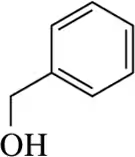
(a) Chemical structure of phenol, featuring a hydroxyl group (OH) attached to a benzene ring.

검증된 단계별 안내
1
Identify the functional group in the given molecule. The structure shows a benzyl alcohol, which has a hydroxyl group (-OH) attached to a benzyl group.
Understand the role of the reagents: SOCl2 (thionyl chloride) is commonly used to convert alcohols into alkyl chlorides. NEt3 (triethylamine) acts as a base to neutralize the HCl produced during the reaction.
Predict the reaction mechanism: The hydroxyl group of the benzyl alcohol will react with SOCl2, leading to the formation of a benzyl chloride. The reaction proceeds via the formation of an intermediate chlorosulfite ester, which then decomposes to form the alkyl chloride.
Consider the stereochemistry: Since the starting material is benzyl alcohol, which is not chiral, the stereochemistry is not a concern in this reaction.
Write the expected product: The product of this reaction will be benzyl chloride, where the hydroxyl group is replaced by a chlorine atom.

비슷한 문제에 대한 검증된 영상 답변:

이 영상 해법은 위 문제에 도움이 된다고 튜터들이 추천한 것입니다.
도움이 되었나요?

주요 개념

질문에 올바르게 답하기 위해 반드시 이해해야 하는 핵심 개념들은 다음과 같습니다.

Thionyl Chloride (SOCl2) Reaction with Alcohols

Thionyl chloride (SOCl2) is commonly used to convert alcohols into alkyl chlorides. The reaction involves the substitution of the hydroxyl group (OH) with a chlorine atom (Cl), facilitated by the formation of a chlorosulfite intermediate. This reaction is often carried out in the presence of a base, such as triethylamine (NEt3), to neutralize the HCl byproduct and drive the reaction to completion.
추천 영상:
01:44
Forming alcohols through SN2 reactions.

Role of Triethylamine (NEt3)

Triethylamine (NEt3) acts as a base in reactions involving thionyl chloride and alcohols. Its primary role is to capture the hydrogen chloride (HCl) produced during the reaction, preventing the formation of acidic conditions that could lead to side reactions or decomposition of the product. By neutralizing HCl, NEt3 helps in maintaining a favorable environment for the conversion of alcohols to alkyl chlorides.
추천 영상:
05:09
Heck Reaction

Reactivity of Benzyl Alcohol

Benzyl alcohol, characterized by a hydroxyl group attached to a benzene ring, is a primary alcohol that readily undergoes substitution reactions. In the presence of thionyl chloride and a base, benzyl alcohol can be efficiently converted to benzyl chloride. The aromatic ring does not participate directly in the reaction, but its presence can influence the reaction conditions and the stability of intermediates.
추천 영상:
가이드 코스
0:58
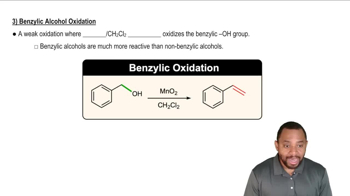
Reactions at Benzylic Positions Concept 4
관련 실천
교과서 질문

Predict the product(s) that would result when molecules (a)–(p) are allowed to react under the following conditions: (xi) HOCl, H₂O (xii) HIO₄. If no reaction occurs, write 'no reaction.'  

(a)

739
views

교과서 질문

Predict the product(s) that would result when molecules (a)–(p) are allowed to react under the following conditions: (i) SOCl₂ ; (ii) PBr₃. If no reaction occurs, write 'no reaction.'  

(a)

870
views
교과서 질문

Predict the product(s) that would result when molecules (a)–(p) are allowed to react under the following conditions: (i) SOCl₂ ; (iii) SOCl₂, NEt₃. If no reaction occurs, write 'no reaction.'

(c)

585
views
교과서 질문

Predict the product(s) that would result when molecules (a)–(p) are allowed to react under the following conditions: (vi) H₂SO₄. If no reaction occurs, write 'no reaction.'  

(a)

681
views
교과서 질문

Predict the product(s) that would result when molecules (a)–(p) are allowed to react under the following conditions: (i) SOCl₂ ; (ii) PBr₃ ; (iii) SOCl₂ , NEt₃ (iv) 1. TsCl, Et₃N 2. NaCN; (v) 1. TsCl, Et₃N 2. NaOt-Bu (vi) H₂SO₄ (vii) HCl; (viii) HBr; (ix) PCC; (x) H₂CrO₄ , H₂O (xi) HOCl, H₂O (xii) HIO₄ If no reaction occurs, write 'no reaction.'

(c)

710
views
교과서 질문

Predict the product(s) that would result when molecules (a)–(p) are allowed to react under the following conditions: (vii) HCl; (viii) HBr. If no reaction occurs, write 'no reaction.'  

(a)

760
views