Ch. 17 - Carbonyl Addition Reactions: Aldehydes and Ketones
Mullins - Organic Chemistry: A Learner Centered Approach 1st Edition
Mullins1st EditionOrganic Chemistry: A Learner Centered ApproachISBN: 9780137566471당신이 사용하는 게 아니라요?교과서 변경
16장, 문제 1d

In each case, circle the stronger nucleophile.
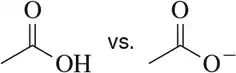
(d) Chemical structures comparing hydroxide and oxide ions, highlighting the stronger nucleophile with a circle.

검증된 단계별 안내
1
Step 1: Understand the concept of nucleophilicity. Nucleophilicity refers to the ability of a species to donate a pair of electrons to an electrophile. Stronger nucleophiles are typically more negatively charged, less sterically hindered, and less stabilized by resonance or electronegative atoms.
Step 2: Analyze the chemical structures provided. Formic acid (a) has a neutral hydroxyl group (-OH) attached to the carbonyl carbon, while formate (b) is the conjugate base of formic acid and carries a negative charge on the oxygen atom.
Step 3: Consider the role of charge. Negatively charged species, like formate (b), are generally stronger nucleophiles than their neutral counterparts because the negative charge increases their electron density, making them more reactive.
Step 4: Evaluate resonance stabilization. Formate (b) has resonance structures that delocalize the negative charge, but it still retains a higher electron density compared to the neutral formic acid (a), making it a stronger nucleophile.
Step 5: Conclude that formate (b) is the stronger nucleophile compared to formic acid (a) due to its negative charge and higher electron density.

비슷한 문제에 대한 검증된 영상 답변:

이 영상 해법은 위 문제에 도움이 된다고 튜터들이 추천한 것입니다.
영상 길이:
2m
도움이 되었나요?

주요 개념

질문에 올바르게 답하기 위해 반드시 이해해야 하는 핵심 개념들은 다음과 같습니다.

Nucleophilicity

Nucleophilicity refers to the ability of a species to donate an electron pair to an electrophile during a chemical reaction. Stronger nucleophiles are typically negatively charged or have lone pairs of electrons that can be readily donated. In this context, comparing formic acid and formate involves assessing their ability to act as nucleophiles based on their structure and charge.
추천 영상:
08:27
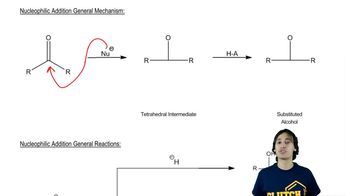
Nucleophilic Addition

Acid-Base Chemistry

Understanding acid-base chemistry is crucial for determining nucleophilicity. Formic acid (a weak acid) can donate a proton (H+) to form the formate ion, which is its conjugate base. The presence of a negative charge on formate enhances its nucleophilicity compared to the neutral formic acid, making it a stronger nucleophile in reactions.
추천 영상:
02:49
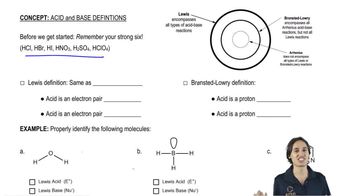
The Lewis definition of acids and bases.

Resonance Stabilization

Resonance stabilization plays a significant role in the reactivity of nucleophiles. The formate ion can delocalize its negative charge over the oxygen atoms, which stabilizes the ion and enhances its nucleophilic character. In contrast, formic acid lacks this resonance stabilization for nucleophilic attack, making formate the stronger nucleophile in this comparison.
추천 영상:
03:43
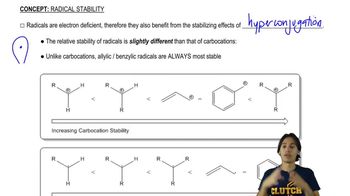
The radical stability trend.