Ch. 17 - Carbonyl Addition Reactions: Aldehydes and Ketones
Mullins - Organic Chemistry: A Learner Centered Approach 1st Edition
Mullins1st EditionOrganic Chemistry: A Learner Centered ApproachISBN: 9780137566471당신이 사용하는 게 아니라요?교과서 변경
16장, 문제 1b

In each case, circle the stronger nucleophile.
(b) Structural comparison of hydroxyl (OH) and amino (NH2) groups, highlighting the stronger nucleophile.

검증된 단계별 안내
1
Step 1: Understand the concept of nucleophilicity. Nucleophilicity refers to the ability of a species to donate a pair of electrons to an electrophile. It is influenced by factors such as charge, electronegativity, steric hindrance, and the solvent used.
Step 2: Compare the electronegativity of the atoms involved. Oxygen (in -OH) is more electronegative than nitrogen (in -NH2), meaning oxygen holds onto its electrons more tightly, making it less likely to donate them compared to nitrogen.
Step 3: Consider the lone pair availability. Nitrogen in -NH2 has a lone pair of electrons that is less tightly held due to its lower electronegativity, making it a stronger nucleophile compared to oxygen in -OH.
Step 4: Evaluate the steric hindrance. Both -OH and -NH2 groups are similar in size and steric hindrance, so this factor does not significantly affect their nucleophilicity in this comparison.
Step 5: Conclude based on the above factors. Nitrogen in -NH2 is the stronger nucleophile compared to oxygen in -OH due to its lower electronegativity and greater ability to donate electrons.

비슷한 문제에 대한 검증된 영상 답변:

이 영상 해법은 위 문제에 도움이 된다고 튜터들이 추천한 것입니다.

주요 개념

질문에 올바르게 답하기 위해 반드시 이해해야 하는 핵심 개념들은 다음과 같습니다.

Nucleophilicity

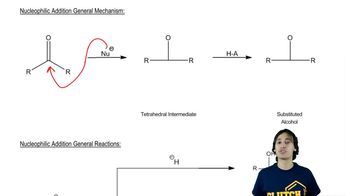
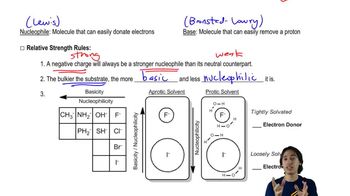
Nucleophilicity refers to the ability of a species to donate an electron pair to an electrophile during a chemical reaction. Stronger nucleophiles are more reactive and can more readily form bonds with electrophiles. Factors influencing nucleophilicity include charge, electronegativity, and steric hindrance.
추천 영상:
08:27
Nucleophilic Addition

Functional Groups

Functional groups are specific groups of atoms within molecules that are responsible for the characteristic chemical reactions of those molecules. In this case, the hydroxyl group (–OH) and the amino group (–NH2) are functional groups that influence the nucleophilicity of the compounds they are part of, with the amino group generally being a stronger nucleophile.
추천 영상:
02:36
Identifying Functional Groups

Basicity and Nucleophilicity Relationship

Basicity and nucleophilicity are related concepts, as both involve the donation of electron pairs. However, basicity refers to the ability to accept protons (H+), while nucleophilicity focuses on the ability to donate electrons to electrophiles. Generally, stronger bases are also stronger nucleophiles, but this is not always the case due to steric and solvent effects.
추천 영상:
06:21
Understanding the difference between basicity and nucleophilicity.