Ch. 2 - General Chemistry Translated: Finding the Electrons
Mullins - Organic Chemistry: A Learner Centered Approach 1st Edition
Mullins1st EditionOrganic Chemistry: A Learner Centered ApproachISBN: 9780137566471당신이 사용하는 게 아니라요?교과서 변경
1장, 문제 78

Carbon dioxide (CO2) has no dipole moment (μ = 0 D). The related molecule sulfur dioxide (SO2) does have a dipole moment (μ = 1.6 D) Explain this observation.

검증된 단계별 안내
1
Step 1: Begin by analyzing the molecular geometry of carbon dioxide (CO₂). CO₂ is a linear molecule, meaning the two oxygen atoms are positioned symmetrically on either side of the central carbon atom. This symmetry causes the dipole moments of the C=O bonds to cancel each other out, resulting in a net dipole moment of μ = 0 D.
Step 2: Next, examine the molecular geometry of sulfur dioxide (SO₂). SO₂ is a bent molecule due to the presence of lone pairs on the central sulfur atom. This bent geometry prevents the dipole moments of the S=O bonds from canceling out completely, leading to a net dipole moment.
Step 3: Consider the electronegativity differences between the atoms in each molecule. In CO₂, the carbon atom is less electronegative than oxygen, creating dipole moments in the C=O bonds. However, the linear geometry ensures these dipole moments are equal in magnitude but opposite in direction, resulting in no net dipole moment.
Step 4: For SO₂, sulfur is less electronegative than oxygen, creating dipole moments in the S=O bonds. Due to the bent geometry, the dipole moments do not cancel out, and the molecule has a net dipole moment of μ = 1.6 D.
Step 5: Conclude by emphasizing the importance of molecular geometry in determining dipole moments. While both CO₂ and SO₂ have polar bonds, the symmetry of CO₂ leads to no net dipole moment, whereas the asymmetry of SO₂ results in a measurable dipole moment.

비슷한 문제에 대한 검증된 영상 답변:

이 영상 해법은 위 문제에 도움이 된다고 튜터들이 추천한 것입니다.
영상 길이:
9m
도움이 되었나요?

주요 개념

질문에 올바르게 답하기 위해 반드시 이해해야 하는 핵심 개념들은 다음과 같습니다.

Molecular Geometry

Molecular geometry refers to the three-dimensional arrangement of atoms within a molecule. In the case of CO₂, the molecule is linear with a bond angle of 180 degrees, leading to symmetrical charge distribution. Conversely, SO₂ has a bent shape due to the presence of a lone pair on the sulfur atom, resulting in an uneven distribution of electron density.
추천 영상:
07:44
Molecular Geometry Explained.

Dipole Moment

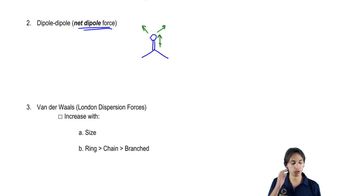
A dipole moment is a measure of the separation of positive and negative charges in a molecule, indicating its polarity. It arises when there is a difference in electronegativity between bonded atoms, leading to partial positive and negative charges. CO₂, being nonpolar, has a dipole moment of zero, while SO₂, with its polar bonds and bent geometry, has a measurable dipole moment of 1.6 D.
추천 영상:
01:46
How dipole-dipole forces work.

Electronegativity

Electronegativity is the tendency of an atom to attract electrons in a chemical bond. In SO₂, sulfur is less electronegative than oxygen, creating polar covalent bonds. This difference in electronegativity contributes to the overall dipole moment of the molecule, as the unequal sharing of electrons leads to a net dipole, unlike in CO₂ where the symmetrical arrangement cancels out any dipole effects.
추천 영상:
1:47
Electronegativity