Ch. 2 - General Chemistry Translated: Finding the Electrons
Mullins - Organic Chemistry: A Learner Centered Approach 1st Edition
Mullins1st EditionOrganic Chemistry: A Learner Centered ApproachISBN: 9780137566471당신이 사용하는 게 아니라요?교과서 변경
1장, 문제 79

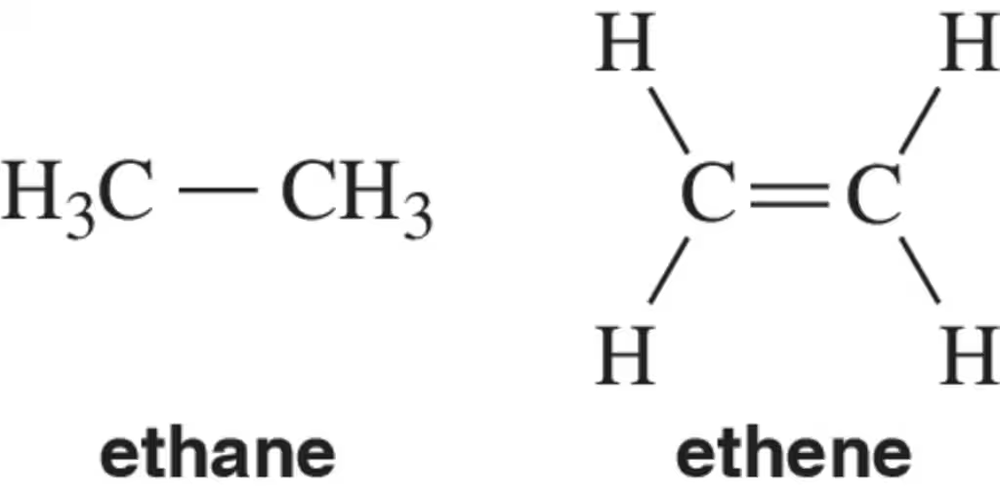
There is free rotation around the C―C bond in ethane. There is an extremely high barrier to rotation around the C=C bond in in ethene. Explain.
Structural formulas of ethane and ethene, highlighting free rotation in ethane and restricted rotation in ethene.

검증된 단계별 안내
1
In ethane (C₂H₆), the carbon-carbon bond is a single bond (sigma bond, denoted as σ). A sigma bond is formed by the head-on overlap of atomic orbitals, and it allows for free rotation around the bond axis because the electron density is symmetrically distributed along the bond axis.
In ethene (C₂H₄), the carbon-carbon bond is a double bond, consisting of one sigma bond (σ) and one pi bond (π). The sigma bond is formed by the head-on overlap of orbitals, while the pi bond is formed by the side-by-side overlap of p orbitals above and below the plane of the atoms.
The pi bond in ethene restricts rotation because the side-by-side overlap of the p orbitals would be disrupted if the carbon atoms were to rotate relative to each other. This disruption would break the pi bond, which requires significant energy to overcome.
The energy barrier to rotation around the C=C bond in ethene is extremely high due to the strength of the pi bond. In contrast, the single sigma bond in ethane does not have this restriction, allowing for free rotation.
In summary, the free rotation in ethane is due to the single sigma bond, while the restricted rotation in ethene is due to the presence of the pi bond in the double bond, which prevents rotation without breaking the bond.

비슷한 문제에 대한 검증된 영상 답변:

이 영상 해법은 위 문제에 도움이 된다고 튜터들이 추천한 것입니다.
영상 길이:
5m
도움이 되었나요?

주요 개념

질문에 올바르게 답하기 위해 반드시 이해해야 하는 핵심 개념들은 다음과 같습니다.

C―C Bond Rotation

In ethane, the C―C bond is a single bond, allowing for free rotation around the bond axis. This rotation occurs because single bonds have sigma (σ) bonds formed by the head-on overlap of orbitals, which do not have any significant energy barriers to rotation. As a result, the spatial arrangement of the atoms can change freely without breaking the bond.
추천 영상:
06:00
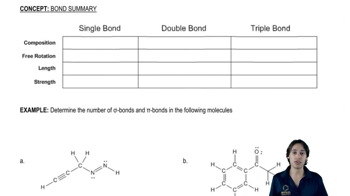
Single bonds, double bonds, and triple bonds.

C=C Bond Characteristics

In contrast, the C=C bond in ethene is a double bond, consisting of one sigma (σ) bond and one pi (π) bond. The pi bond is formed by the side-to-side overlap of p orbitals, which restricts rotation because breaking the pi bond requires significant energy. This results in a high barrier to rotation around the C=C bond, leading to fixed geometries in the molecule.
추천 영상:
가이드 코스
3:15
Disulfide Bonds Example 2

Energy Barriers in Bond Rotation

The energy barrier to rotation around a bond is influenced by the type of bond and the presence of substituents. In ethene, the pi bond creates a substantial energy barrier that must be overcome to rotate the molecule, while in ethane, the absence of such a barrier allows for unrestricted rotation. Understanding these energy dynamics is crucial for predicting molecular behavior and reactivity.
추천 영상:
03:00
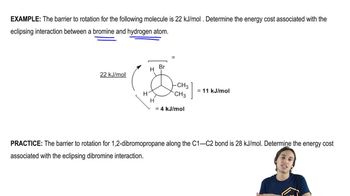
Determining energy cost of eclipsed interaction