Ch. 2 - General Chemistry Translated: Finding the Electrons
Mullins - Organic Chemistry: A Learner Centered Approach 1st Edition
Mullins1st EditionOrganic Chemistry: A Learner Centered ApproachISBN: 9780137566471당신이 사용하는 게 아니라요?교과서 변경
1장, 문제 62v

Draw the Lewis structure for the following molecular formulas.
(v) CH5N

검증된 단계별 안내
1
Step 1: Count the total number of valence electrons in the molecule. Carbon (C) has 4 valence electrons, hydrogen (H) has 1 valence electron each (5 hydrogens contribute 5 electrons), and nitrogen (N) has 5 valence electrons. Add these together to determine the total number of valence electrons available for the Lewis structure.
Step 2: Identify the central atom. In this case, carbon (C) is typically the central atom because it can form the most bonds. Nitrogen (N) will likely be bonded to carbon, and the hydrogens (H) will be distributed around the structure.
Step 3: Arrange the atoms and form single bonds. Place carbon (C) in the center, bond it to nitrogen (N) with a single bond, and attach the hydrogens (H) to the remaining available bonding sites on carbon and nitrogen. Each single bond represents 2 electrons.
Step 4: Distribute the remaining valence electrons to satisfy the octet rule (or duet rule for hydrogen). Start by completing the octet for nitrogen (N) by adding lone pairs if necessary. Ensure that all hydrogens have 2 electrons (a full duet).
Step 5: Verify the structure. Check that the total number of valence electrons used matches the total calculated in Step 1. Also, confirm that all atoms (except hydrogen) satisfy the octet rule and that the structure is stable.

비슷한 문제에 대한 검증된 영상 답변:

이 영상 해법은 위 문제에 도움이 된다고 튜터들이 추천한 것입니다.
영상 길이:
3m
도움이 되었나요?

주요 개념

질문에 올바르게 답하기 위해 반드시 이해해야 하는 핵심 개념들은 다음과 같습니다.

Lewis Structures

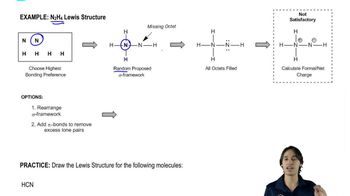
Lewis structures are diagrams that represent the bonding between atoms in a molecule and the lone pairs of electrons that may exist. They use dots to represent valence electrons and lines to indicate bonds between atoms. Understanding how to draw Lewis structures is essential for visualizing molecular geometry and predicting reactivity.
추천 영상:
04:12
Drawing the Lewis Structure for N2H4.

Valence Electrons

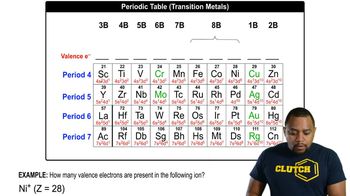
Valence electrons are the outermost electrons of an atom and are crucial in determining how atoms bond with each other. The number of valence electrons influences the molecule's structure and stability. For example, in CH₅N, carbon has four, hydrogen has one, and nitrogen has five valence electrons, which must be accounted for when constructing the Lewis structure.
추천 영상:
03:40
Valence Electrons of Transition Metals

Molecular Geometry

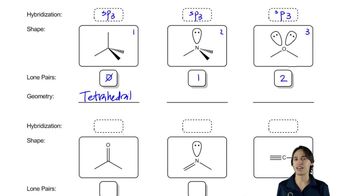
Molecular geometry refers to the three-dimensional arrangement of atoms within a molecule. It is influenced by the number of bonds and lone pairs around the central atom, which can affect the molecule's physical and chemical properties. Understanding molecular geometry helps in predicting the shape of the molecule formed by CH₅N, which is important for its reactivity and interactions.
추천 영상:
07:44
Molecular Geometry Explained.