Ch. 2 - General Chemistry Translated: Finding the Electrons
Mullins - Organic Chemistry: A Learner Centered Approach 1st Edition
Mullins1st EditionOrganic Chemistry: A Learner Centered ApproachISBN: 9780137566471당신이 사용하는 게 아니라요?교과서 변경
1장, 문제 64d

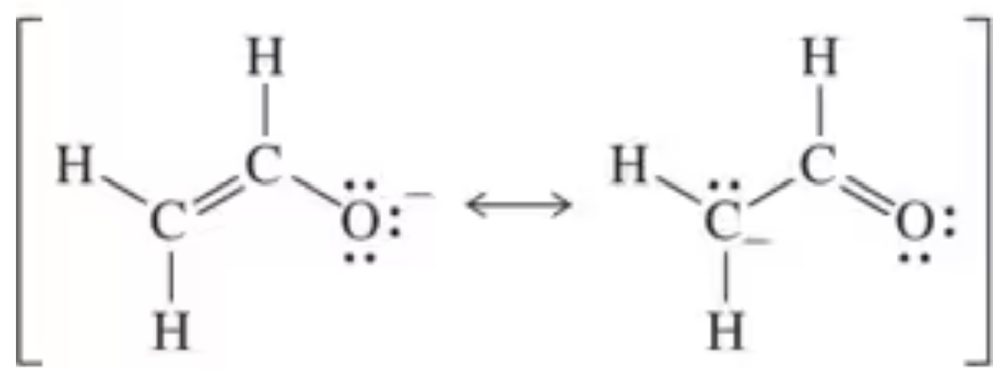
Two resonance structures are shown for each molecule. Use the arrow-pushing formalism to represent the electron flow from the structure on the left to the one on the right.
(d) Two resonance structures of a molecule with arrow-pushing formalism indicating electron flow between them.

검증된 단계별 안내
1
Identify the regions in the molecule where electron movement occurs. Look for lone pairs, π-bonds, or formal charges that can participate in resonance.
Determine the direction of electron flow. Resonance structures involve the movement of electrons, typically from a region of high electron density (like a lone pair or π-bond) to a region of lower electron density (like a positive charge or an adjacent π-system).
Use curved arrows to represent the movement of electrons. Each arrow starts at the source of the electrons (e.g., a lone pair or a bond) and points to where the electrons are moving (e.g., another bond or an atom).
Ensure that the octet rule is satisfied for all atoms involved in the resonance structure. Adjust the placement of electrons accordingly to avoid overfilling or underfilling the valence shell of any atom.
Verify that the resulting resonance structure is valid. Check that the formal charges are correctly assigned and that the overall charge of the molecule remains unchanged between the two resonance structures.

비슷한 문제에 대한 검증된 영상 답변:

이 영상 해법은 위 문제에 도움이 된다고 튜터들이 추천한 것입니다.
영상 길이:
1m
도움이 되었나요?

주요 개념

질문에 올바르게 답하기 위해 반드시 이해해야 하는 핵심 개념들은 다음과 같습니다.

Resonance Structures

Resonance structures are different Lewis structures for the same molecule that depict the same arrangement of atoms but differ in the distribution of electrons. These structures help illustrate the delocalization of electrons within a molecule, which can stabilize it. The actual structure of the molecule is a hybrid of all possible resonance forms, reflecting the true electron density more accurately than any single structure.
추천 영상:
03:04
Drawing Resonance Structures

Arrow-Pushing Formalism

Arrow-pushing formalism is a method used in organic chemistry to depict the movement of electrons during chemical reactions. Curved arrows indicate the direction of electron flow, with the tail of the arrow showing where the electrons are coming from and the head indicating where they are going. This technique is essential for visualizing mechanisms and understanding how reactants transform into products.
추천 영상:
01:34
Calculating formal and net charge.

Electron Flow

Electron flow refers to the movement of electrons during chemical reactions, particularly in the context of bond formation and breaking. Understanding electron flow is crucial for predicting the behavior of molecules during reactions, as it determines how bonds are made or broken. In resonance structures, electron flow can illustrate how electrons are delocalized, affecting the stability and reactivity of the molecule.
추천 영상:
03:54
The 18 and 16 Electron Rule