Ch. 2 - General Chemistry Translated: Finding the Electrons
Mullins - Organic Chemistry: A Learner Centered Approach 1st Edition
Mullins1st EditionOrganic Chemistry: A Learner Centered ApproachISBN: 9780137566471당신이 사용하는 게 아니라요?교과서 변경
1장, 문제 27b

Draw the Lewis structure for the following molecules. Be sure to calculate the formal charge of each atom as a way of confirming your structure is correct.
(b) HOBr

검증된 단계별 안내
1
Step 1: Identify the total number of valence electrons in the molecule. Hydrogen (H) has 1 valence electron, oxygen (O) has 6 valence electrons, and bromine (Br) has 7 valence electrons. Add these together to determine the total number of valence electrons available for bonding.
Step 2: Determine the central atom. In this case, bromine (Br) is the central atom as indicated in the problem. Arrange the atoms with bromine in the center, oxygen bonded to bromine, and hydrogen bonded to oxygen.
Step 3: Draw single bonds between the atoms. Connect bromine to oxygen with a single bond and oxygen to hydrogen with another single bond. Each bond represents two shared electrons.
Step 4: Distribute the remaining valence electrons around the atoms to satisfy the octet rule for oxygen and bromine. Place lone pairs on oxygen and bromine as needed, ensuring that oxygen has 8 electrons and bromine has 8 electrons (including the bonding electrons). Hydrogen only needs 2 electrons to complete its duet.
Step 5: Calculate the formal charge for each atom to confirm the structure is correct. Use the formula: Formal charge = (Valence electrons of the atom) - (Non-bonding electrons) - (1/2 × Bonding electrons). Ensure the sum of formal charges equals the overall charge of the molecule, which is neutral in this case.

비슷한 문제에 대한 검증된 영상 답변:

이 영상 해법은 위 문제에 도움이 된다고 튜터들이 추천한 것입니다.
영상 길이:
3m

주요 개념

질문에 올바르게 답하기 위해 반드시 이해해야 하는 핵심 개념들은 다음과 같습니다.

Lewis Structures

Lewis structures are diagrams that represent the bonding between atoms in a molecule and the lone pairs of electrons that may exist. They help visualize the arrangement of electrons and the connectivity of atoms, allowing chemists to predict molecular geometry and reactivity. In drawing Lewis structures, one must account for the total number of valence electrons available from all atoms involved.
추천 영상:
04:12
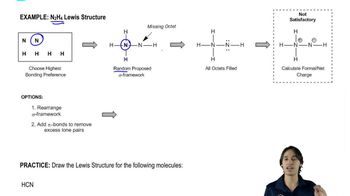
Drawing the Lewis Structure for N2H4.

Formal Charge

Formal charge is a theoretical charge assigned to an atom in a molecule, calculated to help assess the stability of a Lewis structure. It is determined using the formula: Formal Charge = Valence Electrons - (Non-bonding Electrons + 1/2 Bonding Electrons). A structure is generally more stable when the formal charges are minimized and closer to zero, aiding in the validation of the drawn Lewis structure.
추천 영상:
01:34
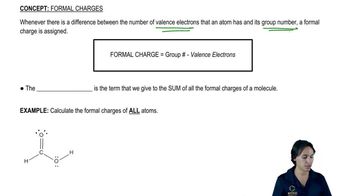
Calculating formal and net charge.

Central Atom Identification

The central atom in a molecule is typically the least electronegative atom that can form multiple bonds, serving as the core around which other atoms are arranged. Identifying the central atom is crucial for accurately constructing the Lewis structure, as it dictates the overall shape and connectivity of the molecule. In the case of HOBr, the central atom is oxygen, which is bonded to both hydrogen and bromine.
추천 영상:
01:44
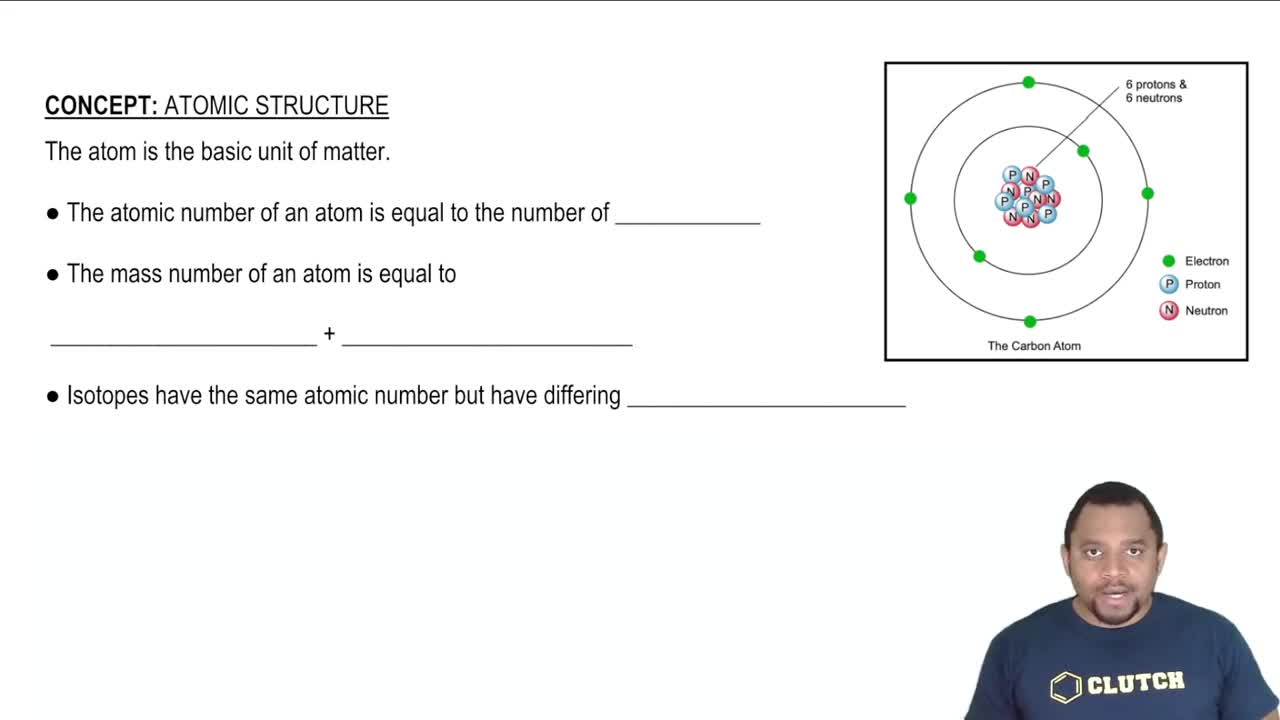
The difference between atomic numbers and atomic mass.