Ch. 2 - General Chemistry Translated: Finding the Electrons
Mullins - Organic Chemistry: A Learner Centered Approach 1st Edition
Mullins1st EditionOrganic Chemistry: A Learner Centered ApproachISBN: 9780137566471당신이 사용하는 게 아니라요?교과서 변경
1장, 문제 24a

Without looking at Figure 2.20, use your intuition to estimate whether a bond is ionic, polar covalent, or covalent.
(a) Na―Cl

검증된 단계별 안내
1
Step 1: Begin by considering the electronegativity difference between the two atoms involved in the bond. Sodium (Na) is a metal with low electronegativity, while chlorine (Cl) is a nonmetal with high electronegativity.
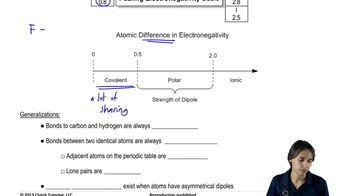
Step 2: Recall the general rule for bond types: If the electronegativity difference is large (greater than 2.0), the bond is likely ionic. If the difference is moderate (between 0.5 and 2.0), the bond is polar covalent. If the difference is small (less than 0.5), the bond is nonpolar covalent.
Step 3: Use your intuition to estimate the electronegativity difference between Na and Cl. Sodium has an electronegativity of approximately 0.9, and chlorine has an electronegativity of approximately 3.0. The difference is significant.
Step 4: Based on the large electronegativity difference, predict that the bond between Na and Cl is ionic. This is because the electron from Na is likely to be completely transferred to Cl, forming ions.
Step 5: After making your prediction, consult Figure 2.20 to confirm whether your estimation aligns with the classification provided in the figure.

비슷한 문제에 대한 검증된 영상 답변:

이 영상 해법은 위 문제에 도움이 된다고 튜터들이 추천한 것입니다.
영상 길이:
1m
도움이 되었나요?

주요 개념

질문에 올바르게 답하기 위해 반드시 이해해야 하는 핵심 개념들은 다음과 같습니다.

Ionic Bonds

Ionic bonds form when there is a complete transfer of electrons from one atom to another, resulting in the formation of charged ions. This typically occurs between metals and nonmetals, where the metal loses electrons to become a positively charged cation, and the nonmetal gains electrons to become a negatively charged anion. The electrostatic attraction between these oppositely charged ions holds them together.
추천 영상:
11:33
Differences between ionic, polar and covalent bonds

Polar Covalent Bonds

Polar covalent bonds occur when two atoms share electrons unequally due to a difference in their electronegativities. In this type of bond, the atom with higher electronegativity attracts the shared electrons more strongly, resulting in a partial negative charge on that atom and a partial positive charge on the other. This creates a dipole moment, which is crucial for understanding molecular polarity and interactions.
추천 영상:
11:33
Differences between ionic, polar and covalent bonds

Covalent Bonds

Covalent bonds are formed when two atoms share one or more pairs of electrons, typically between nonmetals. This sharing allows each atom to attain a stable electron configuration, often resembling that of noble gases. Covalent bonds can be single, double, or triple, depending on the number of shared electron pairs, and they play a fundamental role in the structure and function of organic molecules.
추천 영상:
11:33
Differences between ionic, polar and covalent bonds