Ch. 2 - General Chemistry Translated: Finding the Electrons
Mullins - Organic Chemistry: A Learner Centered Approach 1st Edition
Mullins1st EditionOrganic Chemistry: A Learner Centered ApproachISBN: 9780137566471당신이 사용하는 게 아니라요?교과서 변경
1장, 문제 55i

How many valence electrons does each of the following contribute to a Lewis structure?
(i) Cl

검증된 단계별 안내
1
Step 1: Recall the concept of valence electrons. Valence electrons are the outermost electrons of an atom that participate in chemical bonding. The number of valence electrons for an element can be determined from its position in the periodic table.
Step 2: Locate chlorine (Cl) on the periodic table. Chlorine is in Group 17 (or Group VIIA in older notations), which is the halogen group.
Step 3: Understand that elements in Group 17 have 7 valence electrons because they are one electron short of completing their octet (8 electrons in the outer shell).
Step 4: Write the electron configuration of chlorine to confirm the number of valence electrons. The electron configuration of Cl is: 1s22s22p63s23p5. The outermost shell (n=3) contains 7 electrons (2 in 3s and 5 in 3p).
Step 5: Conclude that chlorine contributes 7 valence electrons to a Lewis structure, which is consistent with its group number and electron configuration.

비슷한 문제에 대한 검증된 영상 답변:

이 영상 해법은 위 문제에 도움이 된다고 튜터들이 추천한 것입니다.
영상 길이:
1m

주요 개념

질문에 올바르게 답하기 위해 반드시 이해해야 하는 핵심 개념들은 다음과 같습니다.

Valence Electrons

Valence electrons are the outermost electrons of an atom and are crucial for determining how an atom will bond with others. They are involved in chemical bonding and reactions, as they can be shared or transferred between atoms. For example, in the case of chlorine (Cl), it has seven valence electrons, which influences its reactivity and the types of bonds it can form.
추천 영상:
03:40
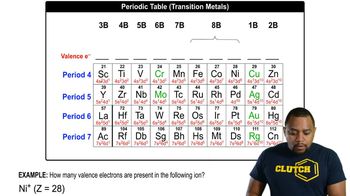
Valence Electrons of Transition Metals

Lewis Structures

Lewis structures are diagrams that represent the bonding between atoms in a molecule and the lone pairs of electrons that may exist. They use dots to represent valence electrons and lines to represent bonds between atoms. Understanding how to draw Lewis structures is essential for visualizing molecular geometry and predicting the behavior of molecules in chemical reactions.
추천 영상:
04:12
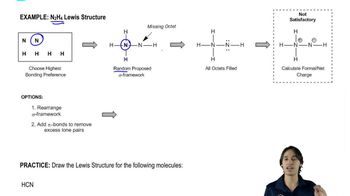
Drawing the Lewis Structure for N2H4.

Chlorine in Lewis Structures

In Lewis structures, chlorine typically contributes seven valence electrons, which allows it to form one covalent bond while having three lone pairs. This configuration is significant because it helps illustrate chlorine's tendency to gain an electron to achieve a stable octet, making it a highly reactive nonmetal. Recognizing chlorine's electron configuration is key to understanding its role in various chemical reactions.
추천 영상:
04:12
Drawing the Lewis Structure for N2H4.