Ch. 2 - General Chemistry Translated: Finding the Electrons
Mullins - Organic Chemistry: A Learner Centered Approach 1st Edition
Mullins1st EditionOrganic Chemistry: A Learner Centered ApproachISBN: 9780137566471당신이 사용하는 게 아니라요?교과서 변경
1장, 문제 55l

How many valence electrons does each of the following contribute to a Lewis structure?
(l) ―1 charge

검증된 단계별 안내
1
Understand the concept of valence electrons: Valence electrons are the outermost electrons of an atom that participate in chemical bonding. For a Lewis structure, we count the valence electrons of all atoms and adjust for any charges present.
Recognize the effect of a negative charge: A negative charge (−1) indicates that the molecule or ion has gained one extra electron. This extra electron must be added to the total count of valence electrons.
Determine the total valence electrons: First, calculate the sum of the valence electrons for all atoms in the molecule or ion. Then, add one additional electron to account for the −1 charge.
Write the Lewis structure: Use the total number of valence electrons (including the extra electron from the −1 charge) to distribute electrons around the atoms, ensuring that each atom satisfies the octet rule (or duet rule for hydrogen) where applicable.
Verify the structure: Ensure that the total number of electrons in the Lewis structure matches the calculated total valence electrons, and confirm that the formal charges on the atoms are consistent with the overall −1 charge.

주요 개념

질문에 올바르게 답하기 위해 반드시 이해해야 하는 핵심 개념들은 다음과 같습니다.

Valence Electrons

Valence electrons are the outermost electrons of an atom and are crucial for determining how an atom will bond with others. They are involved in chemical bonding and reactions, and their number can vary depending on the element. For example, carbon has four valence electrons, while oxygen has six. Understanding the number of valence electrons helps in predicting the structure and reactivity of molecules.
추천 영상:
03:40
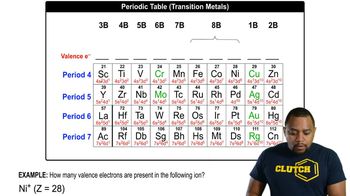
Valence Electrons of Transition Metals

Lewis Structures

Lewis structures are diagrams that represent the bonding between atoms in a molecule and the lone pairs of electrons that may exist. They use dots to represent valence electrons and lines to represent bonds between atoms. This visual representation helps chemists understand the arrangement of electrons and the overall geometry of the molecule, which is essential for predicting its chemical behavior.
추천 영상:
04:12
Drawing the Lewis Structure for N2H4.

Charge Contribution

In the context of Lewis structures, the charge of an ion affects the total number of valence electrons considered. A negatively charged ion (anion) contributes additional electrons, while a positively charged ion (cation) has fewer. For example, a species with a -1 charge contributes one extra valence electron to the Lewis structure, which must be accounted for when drawing the structure and determining the overall electron count.
추천 영상:
01:34
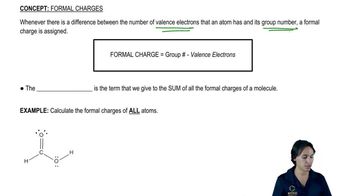
Calculating formal and net charge.