Ch. 2 - General Chemistry Translated: Finding the Electrons
Mullins - Organic Chemistry: A Learner Centered Approach 1st Edition
Mullins1st EditionOrganic Chemistry: A Learner Centered ApproachISBN: 9780137566471당신이 사용하는 게 아니라요?교과서 변경
1장, 문제 4b

How many valence shell electrons do each of the following elements contain? How many new bonds can each form?
(b) N

검증된 단계별 안내
1
Step 1: Identify the group number of nitrogen (N) in the periodic table. Nitrogen is in Group 15 (or Group V in older notation). The group number indicates the number of valence electrons for main group elements.
Step 2: Determine the number of valence electrons for nitrogen. Since nitrogen is in Group 15, it has 5 valence electrons in its outermost shell.
Step 3: Understand the bonding capacity of nitrogen. To achieve a stable octet configuration (8 electrons in the valence shell), nitrogen can form bonds to gain 3 additional electrons.
Step 4: Calculate the number of bonds nitrogen can form. Since nitrogen has 5 valence electrons and needs 3 more to complete its octet, it can form up to 3 covalent bonds.
Step 5: Summarize the findings. Nitrogen has 5 valence electrons and can form 3 new bonds to achieve a stable octet configuration.

비슷한 문제에 대한 검증된 영상 답변:

이 영상 해법은 위 문제에 도움이 된다고 튜터들이 추천한 것입니다.
영상 길이:
4m
도움이 되었나요?

주요 개념

질문에 올바르게 답하기 위해 반드시 이해해야 하는 핵심 개념들은 다음과 같습니다.

Valence Electrons

Valence electrons are the electrons located in the outermost shell of an atom. They play a crucial role in chemical bonding, as they are the electrons involved in forming bonds with other atoms. For nitrogen (N), which is in group 15 of the periodic table, there are five valence electrons.
추천 영상:
03:40
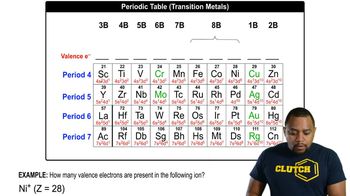
Valence Electrons of Transition Metals

Covalent Bonds

Covalent bonds are formed when two atoms share one or more pairs of valence electrons. The number of covalent bonds an atom can form is determined by the number of unpaired valence electrons it has. In the case of nitrogen, it can form three covalent bonds by sharing its three unpaired valence electrons.
추천 영상:
11:33
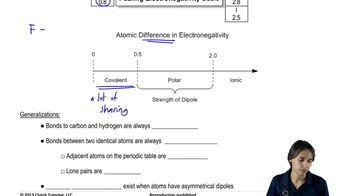
Differences between ionic, polar and covalent bonds

Octet Rule

The octet rule is a chemical principle that states atoms tend to bond in such a way that they each have eight electrons in their valence shell, achieving a stable electron configuration. For nitrogen, which has five valence electrons, it needs three more to complete its octet, thus allowing it to form three bonds with other atoms.
추천 영상:
02:59
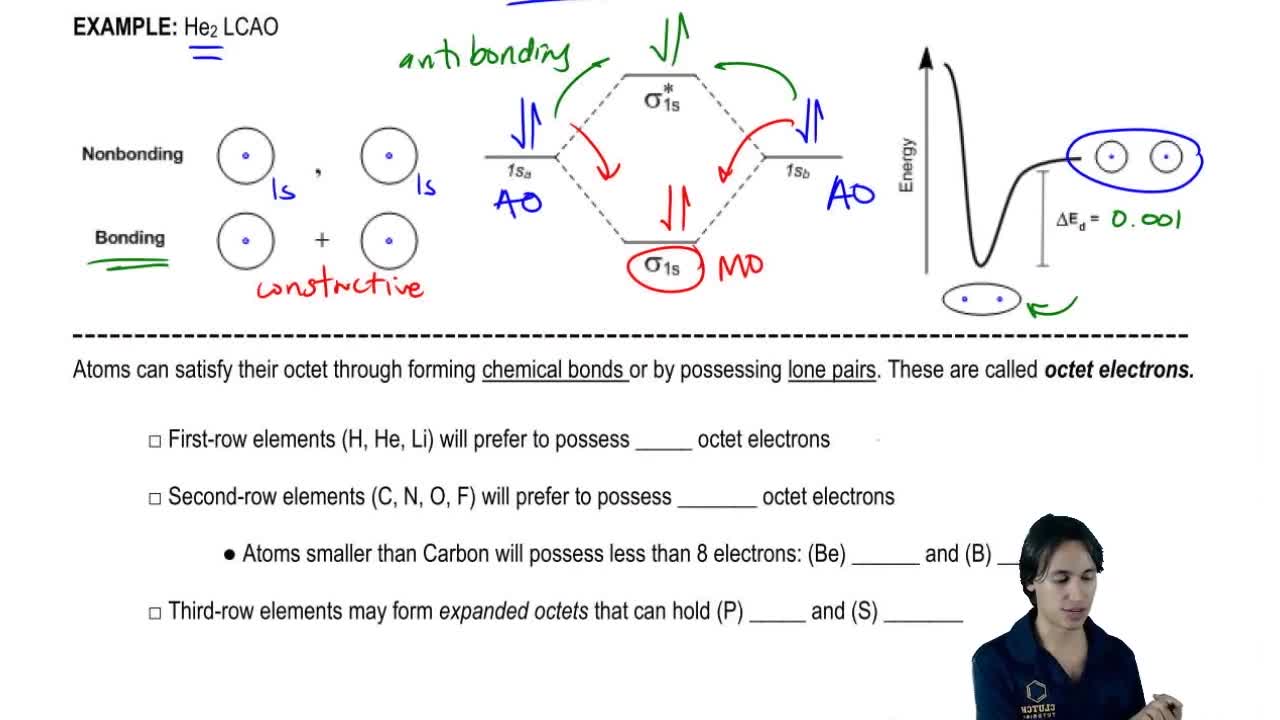
The octet rule.