Chlorine exists as one of two isotopes with atomic masses of 34.969 amu (35Cl) and 36.966 amu (37Cl) . Calculate the relative abundance of 35Cl and 37Cl based on the average atomic mass of 35.453 amu.
Ch. 2 - General Chemistry Translated: Finding the Electrons

Mullins1st EditionOrganic Chemistry: A Learner Centered ApproachISBN: 9780137566471당신이 사용하는 게 아니라요?교과서 변경
1장, 문제 4c
How many valence shell electrons do each of the following elements contain? How many new bonds can each form?
(c) O
검증된 단계별 안내1
Step 1: Determine the group number of oxygen in the periodic table. Oxygen is in Group 16 (or Group VI A in older notations). Elements in this group have 6 valence electrons.
Step 2: Recall that the number of valence electrons corresponds to the electrons in the outermost shell of an atom. For oxygen, this is 6 valence electrons.
Step 3: To determine how many new bonds oxygen can form, consider the octet rule. Atoms tend to form bonds to achieve a full outer shell of 8 electrons.
Step 4: Subtract the number of valence electrons from 8 to find the number of electrons oxygen needs to complete its octet. For oxygen, 8 - 6 = 2 electrons are needed.
Step 5: Conclude that oxygen can form 2 new bonds, as it needs 2 more electrons to complete its octet. These bonds can be single or part of a double bond, depending on the molecule.

비슷한 문제에 대한 검증된 영상 답변:
이 영상 해법은 위 문제에 도움이 된다고 튜터들이 추천한 것입니다.
영상 길이:
2m도움이 되었나요?
주요 개념
질문에 올바르게 답하기 위해 반드시 이해해야 하는 핵심 개념들은 다음과 같습니다.
Valence Electrons
Valence electrons are the outermost electrons of an atom and are crucial for determining how an element interacts and bonds with others. For oxygen (O), which is in group 16 of the periodic table, there are six valence electrons. These electrons are involved in chemical bonding, influencing the element's reactivity and the types of bonds it can form.
추천 영상:
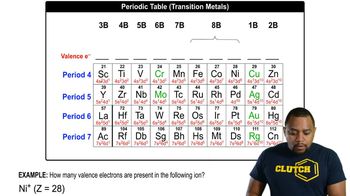
Valence Electrons of Transition Metals
Covalent Bonds
Covalent bonds are formed when two atoms share pairs of electrons, allowing them to achieve a full outer shell and greater stability. Oxygen typically forms two covalent bonds by sharing its six valence electrons with other atoms, such as hydrogen in water (H2O). This ability to form bonds is essential for understanding molecular structures and reactivity.
추천 영상:
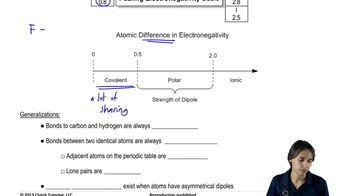
Differences between ionic, polar and covalent bonds
Octet Rule
The octet rule states that atoms tend to form bonds in such a way that they have eight electrons in their valence shell, achieving a stable electron configuration similar to noble gases. For oxygen, which has six valence electrons, forming two bonds allows it to complete its octet, making it more stable. This principle is fundamental in predicting how elements will bond and interact in chemical reactions.
추천 영상:
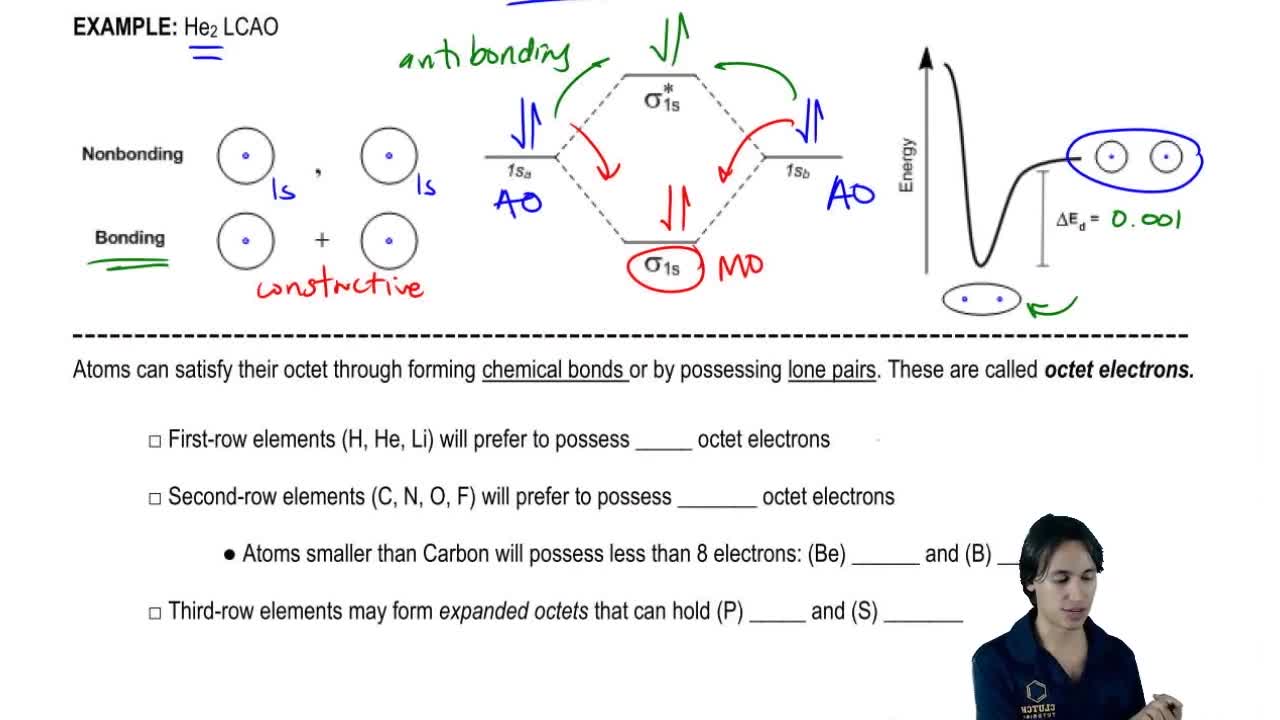
The octet rule.
관련 실천
교과서 질문
1336
views
교과서 질문
Why is argon considered to be so stable that it is referred to as a noble gas?
1466
views
교과서 질문
How many valence shell electrons do each of the following elements contain? How many new bonds can each form?
(a) C
1265
views
교과서 질문
How many valence shell electrons do each of the following elements contain? How many new bonds can each form?
(b) N
1808
views
교과서 질문
Bromine-79 (50.7% abundance) has an atomic mass of 78.918 amu, whereas bromine-81 (49.3% abundance) has an atomic mass of 80.916 amu. From these data, calculate the average atomic mass of bromine that you would expect to see in the periodic table.
1281
views
교과서 질문
Rank the following elements from least electronegative to most electronegative.
Na, Si, F, Mg, C, O, N
1515
views