Looking ahead in Chapter 4, we explain that molecules like CH3+ are Lewis acids or electron pair acceptors. Into which orbital would the new electron pair go?
Ch. 2 - General Chemistry Translated: Finding the Electrons

Mullins1st EditionOrganic Chemistry: A Learner Centered ApproachISBN: 9780137566471당신이 사용하는 게 아니라요?교과서 변경
1장, 문제 85a
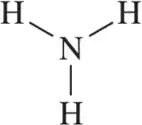
Looking ahead in Chapter 3, we describe how the formal charge on an atom can be used to predict the number of lone pairs. Given the charge, or lack of charge, on each atom, fill in the electron pairs.
(a) 
검증된 단계별 안내1
Identify the formal charge on each atom in the molecule. Recall that formal charge is calculated using the formula: .
Determine the number of valence electrons for each atom based on its position in the periodic table. For example, oxygen has 6 valence electrons, nitrogen has 5, etc.
Using the formal charge and the number of valence electrons, calculate the number of lone pair electrons for each atom. Lone pairs are the non-bonding electrons that remain after accounting for bonding electrons.
Draw the Lewis structure of the molecule, ensuring that the total number of electrons matches the sum of the valence electrons for all atoms in the molecule. Place lone pairs on atoms to satisfy their formal charges and the octet rule (if applicable).
Double-check the structure to ensure that the formal charges on all atoms are consistent with the given information and that the total charge of the molecule matches the overall charge (if any).

비슷한 문제에 대한 검증된 영상 답변:
이 영상 해법은 위 문제에 도움이 된다고 튜터들이 추천한 것입니다.
영상 길이:
4m도움이 되었나요?
주요 개념
질문에 올바르게 답하기 위해 반드시 이해해야 하는 핵심 개념들은 다음과 같습니다.
Formal Charge
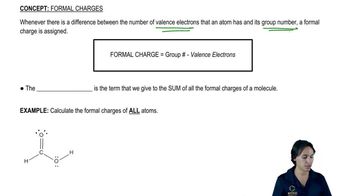
Formal charge is a theoretical charge assigned to an atom in a molecule, calculated by taking the number of valence electrons in the free atom, subtracting the number of non-bonding electrons, and half the number of bonding electrons. It helps in determining the most stable structure of a molecule by minimizing the formal charges across the atoms.
추천 영상:
Calculating formal and net charge.
Lone Pairs
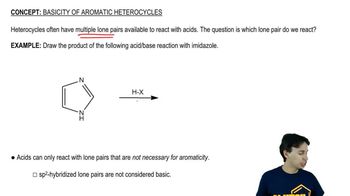
Lone pairs are pairs of valence electrons that are not involved in bonding and are localized on a single atom. They play a crucial role in determining the geometry and reactivity of molecules, as they can influence the shape and polarity of the molecule due to their repulsive interactions with bonding pairs.
추천 영상:
Heterocycles - Which lone pairs react?
Electron Pair Geometry
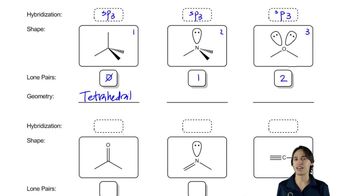
Electron pair geometry refers to the spatial arrangement of all electron pairs (bonding and lone pairs) around a central atom. Understanding this geometry is essential for predicting molecular shapes and angles, which are determined by the repulsion between electron pairs according to VSEPR (Valence Shell Electron Pair Repulsion) theory.
추천 영상:
Molecular Geometry Explained.
관련 실천
교과서 질문
1097
views
교과서 질문
Looking ahead in Chapter 3, we describe how the formal charge on an atom can be used to predict the number of lone pairs. Given the charge, or lack of charge, on each atom, fill in the electron pairs.
(c)
1109
views
교과서 질문
The C―N bond in the following amide is much stronger than the C―N bond in the amine. Explain.
1611
views
교과서 질문
In Chapter 4, we explain that molecules like CH3- are Lewis bases or electron pair donors. What makes it a Lewis base?
1069
views
교과서 질문
In comparison to CH3- in Assessment 2.86, the related molecule BH4- is itself not a Lewis base at boron. Why?
1123
views
교과서 질문
In comparison to CH3+ in Assessment 2.82, the related molecule H3O+ is not a Lewis acid at oxygen. Why?
1047
views