Ch. 2 - General Chemistry Translated: Finding the Electrons
Mullins - Organic Chemistry: A Learner Centered Approach 1st Edition
Mullins1st EditionOrganic Chemistry: A Learner Centered ApproachISBN: 9780137566471당신이 사용하는 게 아니라요?교과서 변경
1장, 문제 87

In comparison to CH3- in Assessment 2.86, the related molecule BH4- is itself not a Lewis base at boron. Why?

검증된 단계별 안내
1
Understand the concept of a Lewis base: A Lewis base is a species that donates a pair of electrons to form a covalent bond. This requires the presence of a lone pair of electrons on the atom in question.
Analyze the structure of CH₃⁻: In CH₃⁻, the carbon atom has a lone pair of electrons, making it capable of donating this pair and acting as a Lewis base.
Examine the structure of BH₄⁻: In BH₄⁻, the boron atom is surrounded by four hydrogen atoms, forming a tetrahedral structure. Boron in this case has a full octet due to the bonding with the hydrogens.
Determine the availability of lone pairs on boron in BH₄⁻: Unlike CH₃⁻, boron in BH₄⁻ does not have a lone pair of electrons. All of its valence electrons are involved in bonding with the hydrogen atoms.
Conclude why BH₄⁻ is not a Lewis base: Since boron in BH₄⁻ lacks a lone pair of electrons to donate, it cannot act as a Lewis base, even though the molecule carries a negative charge. This is a key distinction from CH₃⁻.

비슷한 문제에 대한 검증된 영상 답변:

이 영상 해법은 위 문제에 도움이 된다고 튜터들이 추천한 것입니다.
도움이 되었나요?

주요 개념

질문에 올바르게 답하기 위해 반드시 이해해야 하는 핵심 개념들은 다음과 같습니다.

Lewis Acids and Bases

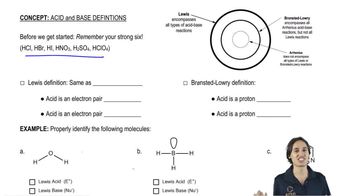
Lewis acids are electron pair acceptors, while Lewis bases are electron pair donors. In the context of boron and carbon compounds, understanding these definitions is crucial for determining the reactivity and classification of molecules. For instance, CH₃⁻ is a Lewis base because it can donate an electron pair, whereas BH₄⁻ does not behave as a Lewis base due to the electron deficiency of boron.
추천 영상:
02:49
The Lewis definition of acids and bases.

Electron Deficiency in Boron

Boron is an electron-deficient element, typically forming three covalent bonds and having an incomplete octet. This characteristic makes boron less likely to donate electron pairs, which is a key trait of Lewis bases. In BH₄⁻, the boron atom is surrounded by four hydrogens, stabilizing its electron configuration but not allowing it to act as a base.
추천 영상:
03:54
The 18 and 16 Electron Rule

Resonance and Stability

Resonance refers to the delocalization of electrons across multiple structures, which can stabilize a molecule. In the case of BH₄⁻, the resonance structures do not allow for the boron atom to effectively donate an electron pair, as the overall stability of the molecule is maintained without it acting as a Lewis base. This contrasts with CH₃⁻, where the carbon can easily donate its lone pair.
추천 영상:
03:43
The radical stability trend.