Ch. 2 - General Chemistry Translated: Finding the Electrons
Mullins - Organic Chemistry: A Learner Centered Approach 1st Edition
Mullins1st EditionOrganic Chemistry: A Learner Centered ApproachISBN: 9780137566471당신이 사용하는 게 아니라요?교과서 변경
1장, 문제 18a

Show the ionic compound that you would expect to form between the given metal and nonmetal. Label the charges on each species.
(a) Al and F

검증된 단계별 안내
1
Step 1: Identify the charges of the metal and nonmetal based on their positions in the periodic table. Aluminum (Al) is in Group 13 and typically forms a +3 charge (Al³⁺). Fluorine (F) is in Group 17 and typically forms a -1 charge (F⁻).
Step 2: Determine the ratio of ions needed to balance the charges. Since Al³⁺ has a +3 charge and F⁻ has a -1 charge, you will need three F⁻ ions to balance the charge of one Al³⁺ ion.
Step 3: Write the formula for the ionic compound by combining the metal and nonmetal in the correct ratio. The formula will be AlF₃, indicating one aluminum ion and three fluoride ions.
Step 4: Label the charges on each species in the compound. Aluminum will have a +3 charge (Al³⁺), and each fluorine will have a -1 charge (F⁻).
Step 5: Verify the overall charge of the compound. The total positive charge from Al³⁺ is +3, and the total negative charge from three F⁻ ions is -3. Since the charges balance, the compound is neutral.

비슷한 문제에 대한 검증된 영상 답변:

이 영상 해법은 위 문제에 도움이 된다고 튜터들이 추천한 것입니다.
영상 길이:
4m
도움이 되었나요?

주요 개념

질문에 올바르게 답하기 위해 반드시 이해해야 하는 핵심 개념들은 다음과 같습니다.

Ionic Bonding

Ionic bonding occurs when electrons are transferred from one atom to another, resulting in the formation of charged ions. Typically, this happens between metals, which lose electrons and become positively charged cations, and nonmetals, which gain electrons to become negatively charged anions. The electrostatic attraction between these oppositely charged ions leads to the formation of an ionic compound.
추천 영상:
가이드 코스
11:33
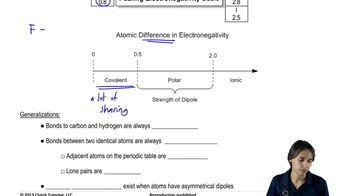
Differences between ionic, polar and covalent bonds

Charge of Ions

The charge of an ion is determined by the number of electrons lost or gained by an atom. For example, aluminum (Al) typically loses three electrons to form a +3 cation (Al³⁺), while fluorine (F) gains one electron to form a -1 anion (F⁻). Understanding the charges of the ions is crucial for predicting the formula of the resulting ionic compound.
추천 영상:
3:39
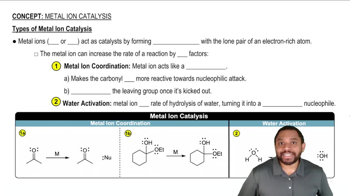
Metal Ion Catalysis Concept 1

Empirical Formula

The empirical formula of an ionic compound represents the simplest whole-number ratio of the ions present. In the case of aluminum and fluorine, the charges of Al³⁺ and F⁻ indicate that three fluoride ions are needed to balance the charge of one aluminum ion, resulting in the empirical formula AlF₃. This formula reflects the stoichiometry of the ionic compound formed.
추천 영상:
가이드 코스
02:17
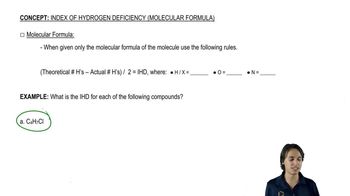
How to use IHD with molecular formula.