Fill in the blank. Oxygen ionizes to become ― 2 instead of ― 1 because O2- is more ___________ .
Ch. 2 - General Chemistry Translated: Finding the Electrons

Mullins1st EditionOrganic Chemistry: A Learner Centered ApproachISBN: 9780137566471당신이 사용하는 게 아니라요?교과서 변경
1장, 문제 20b
(i) Using the periodic trend, choose the more electronegative atom in each pair. For one pair, you'll need to look at the actual Pauling values. (ii) For which one? (iii) Why?
(b) N vs. O
검증된 단계별 안내1
Step 1: Recall the periodic trend for electronegativity. Electronegativity generally increases across a period (left to right) and decreases down a group in the periodic table.
Step 2: Identify the position of nitrogen (N) and oxygen (O) in the periodic table. Both elements are in the same period (Period 2), but oxygen is to the right of nitrogen.
Step 3: Based on the periodic trend, oxygen is expected to be more electronegative than nitrogen because it is further to the right in the same period.
Step 4: To confirm this, look at the actual Pauling electronegativity values. Nitrogen has a value of approximately 3.0, while oxygen has a value of approximately 3.5. This confirms that oxygen is more electronegative.
Step 5: Explain why oxygen is more electronegative. Oxygen has a higher nuclear charge (more protons in the nucleus) compared to nitrogen, which results in a stronger attraction for electrons in a covalent bond.

비슷한 문제에 대한 검증된 영상 답변:
이 영상 해법은 위 문제에 도움이 된다고 튜터들이 추천한 것입니다.
영상 길이:
1m도움이 되었나요?
주요 개념
질문에 올바르게 답하기 위해 반드시 이해해야 하는 핵심 개념들은 다음과 같습니다.
Electronegativity
Electronegativity is a measure of an atom's ability to attract and hold onto electrons in a chemical bond. It is a key concept in understanding how atoms interact in molecules. The Pauling scale is commonly used to quantify electronegativity values, with higher values indicating a stronger tendency to attract electrons.
추천 영상:
Electronegativity
Periodic Trends
Periodic trends refer to the predictable patterns observed in the properties of elements as you move across or down the periodic table. Electronegativity generally increases across a period from left to right and decreases down a group. This trend is crucial for comparing the electronegativity of elements like nitrogen (N) and oxygen (O) in the given question.
추천 영상:
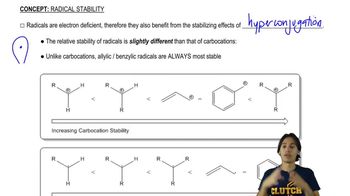
The radical stability trend.
Pauling Scale
The Pauling scale is a numerical scale for measuring electronegativity, developed by Linus Pauling. It assigns values to elements based on their ability to attract electrons in a bond, with fluorine being the most electronegative at 4.0. For the pair N vs. O, the actual Pauling values (3.0 for N and 3.5 for O) indicate that oxygen is more electronegative, which is essential for answering the question.
추천 영상:
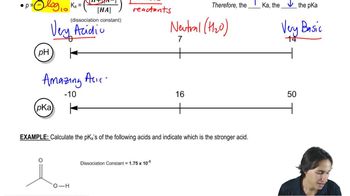
The pH scale vs. the pKa scale.
관련 실천
교과서 질문
1220
views
교과서 질문
Based on your answer to Assessment 2.22, would you expect a larger atom to be more or less electronegative than a smaller atom?
1003
views
교과서 질문
Show the ionic compound that you would expect to form between the given metal and nonmetal. Label the charges on each species.
(a) Al and F
1233
views
교과서 질문
Show the ionic compound that you would expect to form between the given metal and nonmetal. Label the charges on each species.
(b) Mg and Br
1086
views
교과서 질문
(i) Using the periodic trend, choose the more electronegative atom in each pair. For one pair, you'll need to look at the actual Pauling values. (ii) For which one? (iii) Why?
(d) B vs. Si
1077
views
교과서 질문
Without looking at Figure 2.20, use your intuition to estimate whether a bond is ionic, polar covalent, or covalent.
(a) Na―Cl
1157
views