Ch. 21 - Conjugated Systems 1: Stability and Addition Reactions
Mullins - Organic Chemistry: A Learner Centered Approach 1st Edition
Mullins1st EditionOrganic Chemistry: A Learner Centered ApproachISBN: 9780137566471당신이 사용하는 게 아니라요?교과서 변경
20장, 문제 21

Would you expect the following nucleophiles to do 1,2- or 1,4-addition? a. b. c.

검증된 단계별 안내
1
insert step 1
insert step 2
insert step 3
insert step 4
insert step 5

비슷한 문제에 대한 검증된 영상 답변:

이 영상 해법은 위 문제에 도움이 된다고 튜터들이 추천한 것입니다.

주요 개념

질문에 올바르게 답하기 위해 반드시 이해해야 하는 핵심 개념들은 다음과 같습니다.

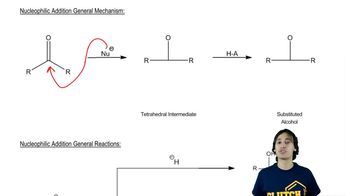
Nucleophilicity

Nucleophilicity refers to the ability of a species to donate an electron pair to an electrophile, forming a chemical bond. Strong nucleophiles, such as alkoxides or amines, are more likely to participate in addition reactions. The strength of a nucleophile can be influenced by factors such as charge, electronegativity, and steric hindrance.
추천 영상:
08:27
Nucleophilic Addition

1,2- and 1,4-Addition Reactions

1,2- and 1,4-addition reactions describe the positions where nucleophiles add to conjugated systems, such as α,β-unsaturated carbonyl compounds. In 1,2-addition, the nucleophile attacks the carbonyl carbon, while in 1,4-addition, it attacks the β-carbon. The preference for one pathway over the other often depends on the nucleophile's strength and the reaction conditions.
추천 영상:
가이드 코스
1:42
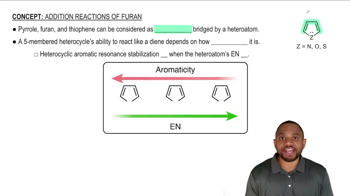
Addition Reactions of Furan Concept 1

Electrophilic Sites

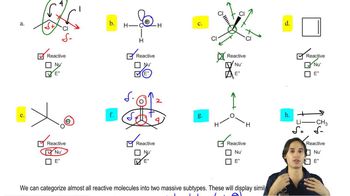
Electrophilic sites are regions in a molecule that are electron-deficient and can attract nucleophiles. In the context of 1,2- and 1,4-addition, the carbonyl carbon of an α,β-unsaturated carbonyl compound is a strong electrophile due to resonance stabilization. Understanding the location and nature of these electrophilic sites is crucial for predicting the outcome of nucleophilic addition reactions.
추천 영상:
03:
Nucleophile or Electrophile