Ch. 22 - Conjugated Systems 2: Pericyclic Reactions
Mullins - Organic Chemistry: A Learner Centered Approach 1st Edition
Mullins1st EditionOrganic Chemistry: A Learner Centered ApproachISBN: 9780137566471당신이 사용하는 게 아니라요?교과서 변경
21장, 문제 40a

Predict the product of the Cope reactions shown.
(a) Chemical structure of a cyclobutene derivative undergoing a Cope rearrangement with heat indicated by a delta symbol.

검증된 단계별 안내
1
Identify the structure of the starting material: The Cope rearrangement involves a 1,5-diene system. Look for a six-membered transition state that can form from the starting material.
Draw the transition state: Visualize the six-membered cyclic transition state that forms during the Cope rearrangement. This involves a concerted movement of electrons, where the π-bonds and σ-bonds are reorganized.
Determine the new bond formation: In the transition state, identify which bonds are breaking and which new bonds are forming. This will help you predict the structure of the product.
Consider stereochemistry: If the starting material has stereocenters, consider how the rearrangement might affect the stereochemistry of the product. The Cope rearrangement is a pericyclic reaction, which often preserves stereochemistry.
Draw the product: Based on the rearrangement and the new bond formations, draw the structure of the product. Ensure that the connectivity and any relevant stereochemistry are accurately represented.

비슷한 문제에 대한 검증된 영상 답변:

이 영상 해법은 위 문제에 도움이 된다고 튜터들이 추천한 것입니다.

주요 개념

질문에 올바르게 답하기 위해 반드시 이해해야 하는 핵심 개념들은 다음과 같습니다.

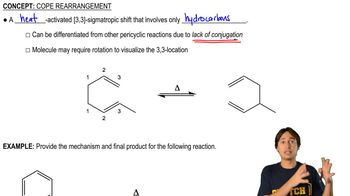
Cope Rearrangement

The Cope rearrangement is a [3,3]-sigmatropic reaction involving the rearrangement of 1,5-dienes. It is a pericyclic reaction where the sigma bonds are broken and formed simultaneously, resulting in a new 1,5-diene. This reaction is thermally induced and proceeds through a cyclic transition state, often leading to the formation of more stable isomers.
추천 영상:
06:28
Definition of Cope Rearrangement

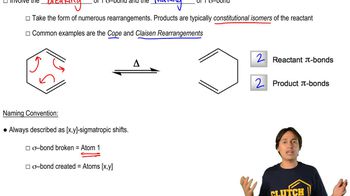
Sigmatropic Rearrangements

Sigmatropic rearrangements are a class of pericyclic reactions where a sigma bond adjacent to one or more pi systems migrates across the pi system. These reactions are characterized by the conservation of orbital symmetry and often involve cyclic transition states. The Cope rearrangement is a specific example of a [3,3]-sigmatropic shift, where the numbers indicate the positions of the atoms involved in the bond migration.
추천 영상:
03:20
Nomenclature of Sigmatropic Shifts

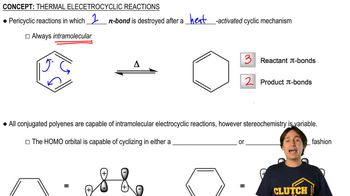
Thermal Activation

Thermal activation refers to the use of heat to provide the energy necessary for a chemical reaction to occur. In the context of the Cope rearrangement, heat is used to overcome the activation energy barrier, allowing the reaction to proceed through its cyclic transition state. The reaction's feasibility and rate can be influenced by the temperature, as well as the stability of the transition state and the final product.
추천 영상:
06:36
MO Theory of Thermal Electrocyclics