Ch. 23 - Benzene 1: Aromatic Stability and Substitution Reactions
Mullins - Organic Chemistry: A Learner Centered Approach 1st Edition
Mullins1st EditionOrganic Chemistry: A Learner Centered ApproachISBN: 9780137566471당신이 사용하는 게 아니라요?교과서 변경
22장, 문제 10

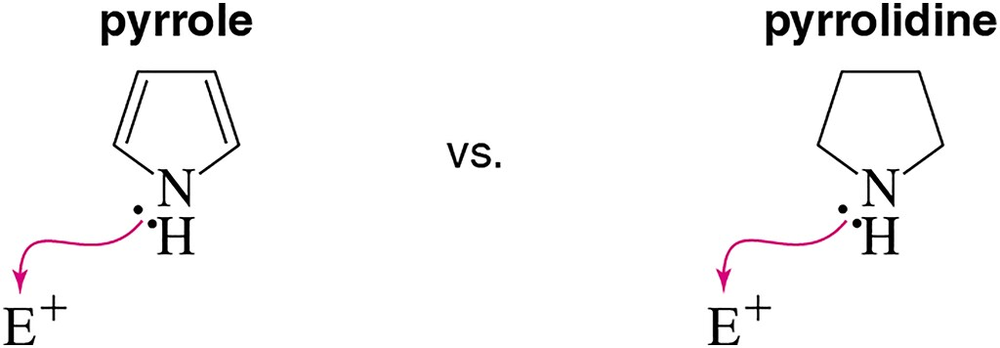
Between pyrrole and pyrrolidine, which nitrogen would be most nucleophilic? Why?

검증된 단계별 안내
1
Understand the structures of pyrrole and pyrrolidine: Pyrrole is a five-membered aromatic ring containing one nitrogen atom, while pyrrolidine is a five-membered saturated ring (non-aromatic) containing one nitrogen atom.
Analyze the electronic environment of the nitrogen in pyrrole: In pyrrole, the nitrogen's lone pair is delocalized into the aromatic π-system, contributing to the aromaticity of the ring. This delocalization reduces the availability of the lone pair for nucleophilic attack.
Analyze the electronic environment of the nitrogen in pyrrolidine: In pyrrolidine, the nitrogen is sp³ hybridized, and its lone pair is localized (not involved in any delocalization or aromaticity). This makes the lone pair more available for nucleophilic attack.
Compare the nucleophilicity of the two nitrogens: Nucleophilicity depends on the availability of the lone pair to donate electrons. Since the lone pair on the nitrogen in pyrrolidine is localized and not involved in aromaticity, it is more nucleophilic than the nitrogen in pyrrole.
Conclude: The nitrogen in pyrrolidine is more nucleophilic than the nitrogen in pyrrole because its lone pair is not delocalized and is more readily available for nucleophilic interactions.

비슷한 문제에 대한 검증된 영상 답변:

이 영상 해법은 위 문제에 도움이 된다고 튜터들이 추천한 것입니다.
영상 길이:
3m

주요 개념

질문에 올바르게 답하기 위해 반드시 이해해야 하는 핵심 개념들은 다음과 같습니다.

Nucleophilicity

Nucleophilicity refers to the ability of a species to donate an electron pair to an electrophile during a chemical reaction. It is influenced by factors such as charge, electronegativity, and steric hindrance. A stronger nucleophile is typically more reactive and can more readily form bonds with electrophiles.
추천 영상:
08:27
Nucleophilic Addition

Aromaticity

Aromaticity is a property of cyclic compounds that exhibit resonance stability due to the delocalization of π electrons. Pyrrole, which contains a nitrogen atom in its ring, is aromatic and has a stable electron cloud, which affects the reactivity of its nitrogen atom compared to non-aromatic compounds like pyrrolidine.
추천 영상:
08:19
Intro to Aromaticity

Basicity of Nitrogen

The basicity of nitrogen in organic compounds is determined by its ability to accept protons (H+). In pyrrole, the nitrogen's lone pair is involved in the aromatic system, making it less available for protonation and nucleophilic attack. In contrast, pyrrolidine has a more available lone pair, making its nitrogen more basic and nucleophilic.
추천 영상:
06:21
Understanding the difference between basicity and nucleophilicity.