Ch. 23 - Benzene 1: Aromatic Stability and Substitution Reactions
Mullins - Organic Chemistry: A Learner Centered Approach 1st Edition
Mullins1st EditionOrganic Chemistry: A Learner Centered ApproachISBN: 9780137566471당신이 사용하는 게 아니라요?교과서 변경
22장, 문제 8

If Kekulé's original hypothesis had been correct and benzene was really an equilibrium between two structures, how many distinct isomers would exist for 1,2-dichlorobenzene?


Diagram of 1,2-dichlorobenzene showing two chlorine atoms on a benzene ring, labeled as one isomer.

검증된 단계별 안내
1
Understand Kekulé's original hypothesis: Kekulé proposed that benzene is an equilibrium between two cyclohexatriene structures, where the double bonds alternate positions.
Consider the structure of 1,2-dichlorobenzene: In the given structure, two chlorine atoms are attached to adjacent carbon atoms in the benzene ring.
Analyze the effect of Kekulé's hypothesis: If benzene were an equilibrium between two structures, the position of the double bonds would change, potentially affecting the relative positions of substituents.
Determine the possible isomers: With alternating double bonds, the positions of the chlorine atoms could lead to different isomers depending on which double bond configuration is present at any given time.
Count the distinct isomers: Consider the different possible arrangements of the chlorine atoms with respect to the alternating double bonds to determine the number of distinct isomers.

비슷한 문제에 대한 검증된 영상 답변:

이 영상 해법은 위 문제에 도움이 된다고 튜터들이 추천한 것입니다.

주요 개념

질문에 올바르게 답하기 위해 반드시 이해해야 하는 핵심 개념들은 다음과 같습니다.

Kekulé Structure of Benzene

Friedrich August Kekulé proposed that benzene is a cyclic compound with alternating single and double bonds, leading to resonance structures. This model suggests that benzene can be represented as an equilibrium between two distinct structures, which influences the understanding of its reactivity and isomerism.
추천 영상:
09:04
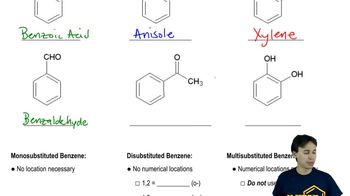
Benzene Nomenclature

Isomerism in Organic Chemistry

Isomerism refers to the phenomenon where compounds have the same molecular formula but different structural arrangements. In the case of 1,2-dichlorobenzene, the presence of two chlorine atoms on the benzene ring can lead to different spatial arrangements, resulting in distinct isomers such as ortho, meta, and para configurations.
추천 영상:
00:56
What is an organic molecule?

Ortho, Meta, and Para Substitution

In aromatic compounds, substitution patterns are categorized as ortho (adjacent positions), meta (one carbon apart), and para (opposite positions). For 1,2-dichlorobenzene, the ortho isomer has both chlorines on adjacent carbons, while the para isomer has them on opposite sides, illustrating how substitution affects the properties and classification of isomers.
추천 영상:
04:42
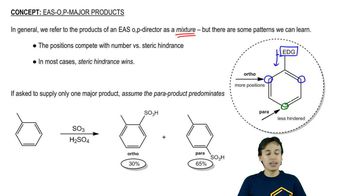
Ortho, Para major products