Ch. 23 - Benzene 1: Aromatic Stability and Substitution Reactions
Mullins - Organic Chemistry: A Learner Centered Approach 1st Edition
Mullins1st EditionOrganic Chemistry: A Learner Centered ApproachISBN: 9780137566471당신이 사용하는 게 아니라요?교과서 변경
22장, 문제 27b

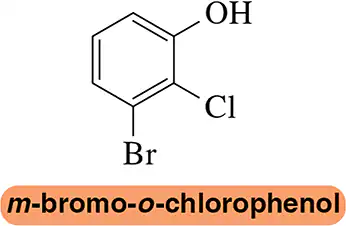
Convert the given name into the corresponding IUPAC name.
(b) Chemical structure of m-bromo-o-chlorophenol with Br, Cl, and OH groups on a benzene ring.

검증된 단계별 안내
1
Identify the parent compound: The parent compound in this structure is phenol, which is a benzene ring with a hydroxyl group (OH) attached.
Number the carbon atoms in the benzene ring: Start numbering from the carbon atom attached to the hydroxyl group (OH) as it is the highest priority functional group. Assign it as carbon 1.
Locate the substituents: Identify the positions of the bromo (Br) and chloro (Cl) groups on the benzene ring. The bromo group is on carbon 3 and the chloro group is on carbon 2.
Assign the IUPAC name: Combine the substituents with their respective positions and the parent compound. The IUPAC name is formed by listing the substituents in alphabetical order with their position numbers, followed by the name of the parent compound.
Construct the final IUPAC name: The IUPAC name for the compound is 2-chloro-3-bromophenol, reflecting the positions and identities of the substituents on the phenol ring.

비슷한 문제에 대한 검증된 영상 답변:

이 영상 해법은 위 문제에 도움이 된다고 튜터들이 추천한 것입니다.
도움이 되었나요?

주요 개념

질문에 올바르게 답하기 위해 반드시 이해해야 하는 핵심 개념들은 다음과 같습니다.

IUPAC Nomenclature

IUPAC nomenclature is a systematic method of naming organic chemical compounds as recommended by the International Union of Pure and Applied Chemistry. It provides a standardized way to name chemical substances, ensuring that each name is unique and universally understood. The rules involve identifying the longest carbon chain, numbering the chain to give substituents the lowest possible numbers, and naming substituents as prefixes.
추천 영상:
03:43
The different parts of an IUPAC name

Aromatic Compounds

Aromatic compounds, such as benzene, are characterized by their stable ring structure with alternating double bonds, known as aromaticity. This stability arises from the delocalization of electrons across the ring, which follows Huckel's rule. In the context of naming, the presence of a benzene ring often serves as the parent structure, with substituents named as prefixes.
추천 영상:
08:19
Intro to Aromaticity

Substituent Positioning on Benzene Rings

In benzene derivatives, substituents are often described by their relative positions on the ring: ortho (o-), meta (m-), and para (p-). 'Ortho' indicates adjacent positions, 'meta' indicates one carbon between substituents, and 'para' indicates opposite positions. In IUPAC naming, these positions are indicated by numbers, with the hydroxyl group (OH) often taking priority as the main functional group.
추천 영상:
09:04
Benzene Nomenclature