Ch. 23 - Benzene 1: Aromatic Stability and Substitution Reactions
Mullins - Organic Chemistry: A Learner Centered Approach 1st Edition
Mullins1st EditionOrganic Chemistry: A Learner Centered ApproachISBN: 9780137566471당신이 사용하는 게 아니라요?교과서 변경
22장, 문제 23

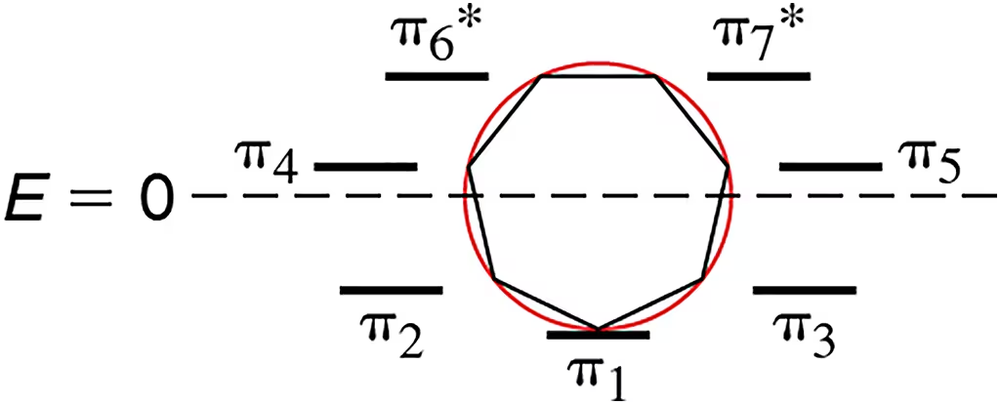
An incomplete Frost diagram for a seven-membered ring is shown. Include the necessary electrons to make it represent an aromatic molecule. Then the draw the structure to which it would correspond.
Incomplete Frost diagram of a seven-membered ring with energy levels for π and π* molecular orbitals.

검증된 단계별 안내
1
Begin by understanding the Frost circle diagram, which is used to determine the energy levels of π molecular orbitals in cyclic conjugated systems. The vertices of the polygon inscribed in a circle represent the energy levels of the π orbitals.
For a seven-membered ring, the Frost diagram shows seven energy levels. To achieve aromaticity, the molecule must follow Huckel's rule, which states that a planar, cyclic molecule is aromatic if it has (4n + 2) π electrons, where n is a non-negative integer.
Count the number of π orbitals below the energy level E = 0. In this diagram, there are three π orbitals below the zero energy level: π1, π2, and π3. These orbitals can hold a total of 6 electrons (2 electrons per orbital).
To make the molecule aromatic, ensure that the total number of π electrons is 6, which satisfies Huckel's rule for n = 1 (since 4n + 2 = 6). Therefore, fill the π1, π2, and π3 orbitals with 2 electrons each.
Draw the structure of the aromatic seven-membered ring. The structure should be a planar cyclic heptagon with alternating single and double bonds, ensuring that the π electrons are delocalized across the ring, contributing to its aromatic stability.

비슷한 문제에 대한 검증된 영상 답변:

이 영상 해법은 위 문제에 도움이 된다고 튜터들이 추천한 것입니다.

주요 개념

질문에 올바르게 답하기 위해 반드시 이해해야 하는 핵심 개념들은 다음과 같습니다.

Aromaticity

Aromaticity is a property of cyclic compounds that exhibit enhanced stability due to the delocalization of π electrons across the ring. For a molecule to be aromatic, it must follow Hückel's rule, which states that it should have 4n + 2 π electrons, where n is a non-negative integer. This delocalization leads to lower energy and increased stability compared to non-aromatic compounds.
추천 영상:
08:19
Intro to Aromaticity

Frost Diagram

A Frost diagram is a graphical representation used to visualize the molecular orbitals of cyclic compounds, particularly in determining their aromaticity. The diagram is constructed by inscribing a polygon (representing the ring) in a circle, where the vertices correspond to the energy levels of the π molecular orbitals. The placement of the vertices helps identify the number of bonding and antibonding orbitals, which is crucial for assessing aromatic stability.
추천 영상:
08:30
Introduction to free energy diagrams.

Molecular Orbital Theory

Molecular Orbital Theory describes the behavior of electrons in molecules by considering the combination of atomic orbitals to form molecular orbitals. These orbitals can be bonding, non-bonding, or antibonding, and their occupancy determines the stability and reactivity of the molecule. In the context of aromatic compounds, the filling of π molecular orbitals according to the Aufbau principle and Hund's rule is essential for understanding their electronic structure and aromatic character.
추천 영상:
08:41
Review of Molecular Orbitals