Ch. 23 - Benzene 1: Aromatic Stability and Substitution Reactions
Mullins - Organic Chemistry: A Learner Centered Approach 1st Edition
Mullins1st EditionOrganic Chemistry: A Learner Centered ApproachISBN: 9780137566471당신이 사용하는 게 아니라요?교과서 변경
22장, 문제 61a

(i) Classify the following molecules as aromatic, nonaromatic, or antiaromatic.
(ii) For aromatic molecules, solve for n in Hückel’s rule. For all other molecules, explain which rule of aromaticity is being broken.
(a) Chemical structure of a nitrogen atom bonded to a carbon atom, illustrating concepts of aromaticity in organic chemistry.

검증된 단계별 안내
1
Identify the structure: The image shows a four-membered ring with a nitrogen atom, which is a cyclobutadiene with a nitrogen atom replacing one of the carbon atoms.
Determine the number of π-electrons: In this structure, there are two π-electrons from the double bond.
Apply Hückel's rule: Aromatic compounds must have (4n + 2) π-electrons, where n is a non-negative integer. Check if 2 fits this formula.
Check planarity and conjugation: For a molecule to be aromatic, it must be planar and fully conjugated. Cyclobutadiene is planar and conjugated.
Classify the molecule: Since the molecule has 4 π-electrons, which fits the 4n rule (n=1), it is antiaromatic. Anti-aromatic compounds are planar, cyclic, and have 4n π-electrons.

비슷한 문제에 대한 검증된 영상 답변:

이 영상 해법은 위 문제에 도움이 된다고 튜터들이 추천한 것입니다.
영상 길이:
2m

주요 개념

질문에 올바르게 답하기 위해 반드시 이해해야 하는 핵심 개념들은 다음과 같습니다.

Aromaticity

Aromaticity refers to a property of cyclic compounds that exhibit enhanced stability due to the delocalization of π electrons across the ring structure. For a molecule to be classified as aromatic, it must be cyclic, planar, fully conjugated, and follow Hückel's rule, which states that the number of π electrons must equal 4n + 2, where n is a non-negative integer.
추천 영상:
08:19
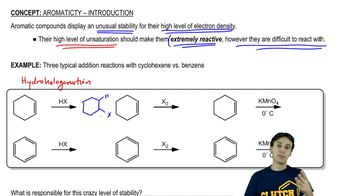
Intro to Aromaticity

Hückel's Rule

Hückel's rule is a criterion used to determine the aromaticity of a compound. It states that a planar, cyclic molecule is aromatic if it contains 4n + 2 π electrons in its conjugated system. This rule helps in identifying aromatic compounds by calculating the total number of π electrons and checking if it fits the formula, thus providing a quantitative measure of aromatic stability.
추천 영상:
03:54
The 18 and 16 Electron Rule

Anti-aromaticity

Anti-aromaticity is a property of cyclic compounds that leads to instability due to the presence of 4n π electrons, which is contrary to Hückel's rule. Such compounds are typically less stable than their non-aromatic counterparts because the electron delocalization does not confer the same level of stabilization. Identifying anti-aromatic compounds involves recognizing the cyclic structure and counting the π electrons to see if they fit the 4n pattern.
추천 영상:
08:19
Intro to Aromaticity