Ch. 23 - Benzene 1: Aromatic Stability and Substitution Reactions
Mullins - Organic Chemistry: A Learner Centered Approach 1st Edition
Mullins1st EditionOrganic Chemistry: A Learner Centered ApproachISBN: 9780137566471당신이 사용하는 게 아니라요?교과서 변경
22장, 문제 60a

Suggest two coupling partners that could be used to synthesize the compounds shown making the indicated C―C bonds.
(a)

검증된 단계별 안내
1
Identify the C―C bond that needs to be formed in the target molecule. This will help in determining the two fragments or coupling partners required for the synthesis.
Consider the use of a common coupling reaction, such as the Suzuki-Miyaura coupling, which involves the reaction between an organoboron compound and an organohalide in the presence of a palladium catalyst.
Determine the retrosynthetic disconnection at the C―C bond. This involves breaking the target molecule into two simpler fragments that can be used as starting materials.
Select the appropriate organoboron compound and organohalide that, when coupled, will form the desired C―C bond. For example, if the target bond is between a phenyl group and an alkyl chain, you might choose a phenylboronic acid and an alkyl halide.
Ensure that the chosen coupling partners are compatible with the reaction conditions and that they will not interfere with other functional groups present in the molecule.

비슷한 문제에 대한 검증된 영상 답변:

이 영상 해법은 위 문제에 도움이 된다고 튜터들이 추천한 것입니다.
영상 길이:
2m

주요 개념

질문에 올바르게 답하기 위해 반드시 이해해야 하는 핵심 개념들은 다음과 같습니다.

Cross-Coupling Reactions

Cross-coupling reactions are a class of reactions in organic chemistry where two different organic groups are joined together through the formation of a carbon-carbon bond. Common examples include the Suzuki, Heck, and Stille reactions, which utilize metal catalysts to facilitate the coupling of organometallic reagents with electrophiles. Understanding these reactions is crucial for identifying suitable coupling partners in synthetic pathways.
추천 영상:
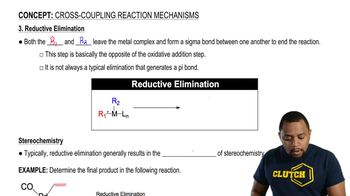
03:22
Cross-Coupling Reaction Mechanisms

Organometallic Reagents

Organometallic reagents are compounds that contain a carbon-metal bond, where the carbon is typically bonded to a metal such as lithium, magnesium, or palladium. These reagents are essential in cross-coupling reactions as they provide the nucleophilic carbon species that can react with electrophiles to form new C―C bonds. Familiarity with the properties and reactivity of various organometallics is vital for selecting appropriate coupling partners.
추천 영상:
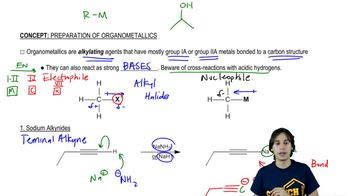
02:50
Ruining Organometallics

Electrophiles in Organic Synthesis

Electrophiles are electron-deficient species that can accept electron pairs from nucleophiles during chemical reactions. In the context of cross-coupling, electrophiles often include halides or other leaving groups that can react with organometallic reagents. Recognizing the nature of potential electrophiles is essential for determining effective coupling partners and predicting the outcome of synthetic reactions.
추천 영상:
가이드 코스
1:16
Synthesis of Amino Acids: Strecker Synthesis Example 1