Ch. 23 - Benzene 1: Aromatic Stability and Substitution Reactions
Mullins - Organic Chemistry: A Learner Centered Approach 1st Edition
Mullins1st EditionOrganic Chemistry: A Learner Centered ApproachISBN: 9780137566471당신이 사용하는 게 아니라요?교과서 변경
22장, 문제 37

In Section 23.7.4, we learned that Friedel–Crafts alkylation suffers from overalkylation.
(a) Draw the product of a Friedel–Crafts reaction that resulted in three methyl groups adding to the ring.
(b) Why is hard to stop at the addition of one alkyl group?


Chemical reaction diagram showing a benzene ring reacting with CH3Cl and AlCl3 to yield a product with three methyl groups.

검증된 단계별 안내
1
Step 1: Understand the Friedel-Crafts alkylation mechanism. This reaction involves the addition of alkyl groups to an aromatic ring using an alkyl halide and a Lewis acid catalyst, such as AlCl3.
Step 2: Recognize the role of the catalyst, AlCl3, which helps generate a carbocation from the alkyl halide (CH3Cl). The carbocation is the electrophile that will attack the aromatic ring.
Step 3: Consider the first alkylation step where the carbocation attacks the benzene ring, forming a new C-C bond and resulting in the addition of a methyl group to the ring.
Step 4: Understand why overalkylation occurs. The addition of the first methyl group increases the electron density of the ring, making it more reactive towards further electrophilic attack, leading to the addition of more methyl groups.
Step 5: Draw the final product with three methyl groups added to the benzene ring. The positions of the methyl groups can be ortho, meta, or para, but typically para and ortho positions are favored due to steric and electronic effects.

비슷한 문제에 대한 검증된 영상 답변:

이 영상 해법은 위 문제에 도움이 된다고 튜터들이 추천한 것입니다.
영상 길이:
7m

주요 개념

질문에 올바르게 답하기 위해 반드시 이해해야 하는 핵심 개념들은 다음과 같습니다.

Friedel–Crafts Alkylation

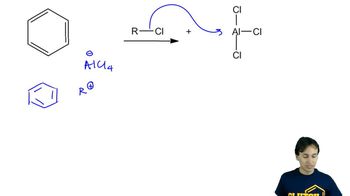
Friedel–Crafts alkylation is an electrophilic aromatic substitution reaction where an alkyl group is introduced to an aromatic ring using an alkyl halide and a Lewis acid catalyst. This reaction allows for the formation of new carbon-carbon bonds, enhancing the complexity of aromatic compounds. However, it often leads to multiple alkylation events, resulting in overalkylation.
추천 영상:
06:30
Friedel-Crafts Alkylation

Overalkylation

Overalkylation refers to the phenomenon where multiple alkyl groups are added to an aromatic ring during a Friedel–Crafts reaction, rather than just one. This occurs because the alkylated aromatic compound can still act as a nucleophile, making it susceptible to further electrophilic attack. The stability of the resulting carbocation intermediates also contributes to this tendency.

Carbocation Stability

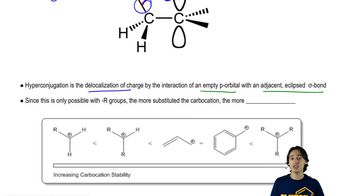
Carbocation stability is a key factor in determining the reactivity of intermediates in organic reactions. In Friedel–Crafts alkylation, the formation of a stable carbocation from the alkyl halide is crucial for the reaction to proceed. More substituted carbocations are generally more stable, which can lead to increased reactivity and the likelihood of multiple alkylation events occurring.
추천 영상:
05:58
Determining Carbocation Stability