Ch. 23 - Benzene 1: Aromatic Stability and Substitution Reactions
Mullins - Organic Chemistry: A Learner Centered Approach 1st Edition
Mullins1st EditionOrganic Chemistry: A Learner Centered ApproachISBN: 9780137566471당신이 사용하는 게 아니라요?교과서 변경
22장, 문제 39

With a small electron-donating group on the ring, it is possible to get as much as a 2:1 ratio of ortho to para. Why might this be?

검증된 단계별 안내
1
Identify the electron-donating group on the benzene ring. In this case, the methyl group (CH₃) is the electron-donating group.
Understand that electron-donating groups activate the benzene ring towards electrophilic aromatic substitution, making the ortho and para positions more reactive.
Recognize that the ortho position is sterically hindered compared to the para position, but the methyl group is small, reducing steric hindrance and allowing for significant ortho substitution.
Consider the resonance effect: the electron-donating group increases electron density at the ortho and para positions, stabilizing the carbocation intermediate formed during the reaction.
Conclude that the combination of electronic effects (activation and resonance stabilization) and reduced steric hindrance leads to a higher ratio of ortho to para substitution, resulting in the observed 2:1 ratio.

비슷한 문제에 대한 검증된 영상 답변:

이 영상 해법은 위 문제에 도움이 된다고 튜터들이 추천한 것입니다.
도움이 되었나요?

주요 개념

질문에 올바르게 답하기 위해 반드시 이해해야 하는 핵심 개념들은 다음과 같습니다.

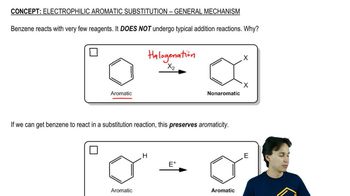
Electrophilic Aromatic Substitution (EAS)

Electrophilic Aromatic Substitution is a reaction where an electrophile replaces a hydrogen atom on an aromatic ring. In the presence of a catalyst like FeCl3, chlorine acts as the electrophile, attacking the benzene ring. The position of substitution is influenced by existing substituents on the ring, which can direct the incoming group to ortho, meta, or para positions.
추천 영상:
03:07
EAS Review

Ortho/Para Directing Groups

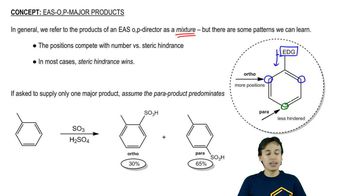
Ortho/para directing groups are substituents on an aromatic ring that increase the electron density at the ortho and para positions, making them more reactive to electrophilic attack. Electron-donating groups, such as alkyl groups, stabilize the carbocation intermediate formed during EAS, favoring substitution at these positions. This explains the higher ratio of ortho to para products in the presence of such groups.
추천 영상:
04:42
Ortho, Para major products

Steric and Electronic Effects

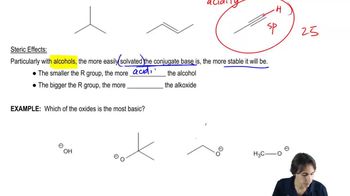
Steric and electronic effects influence the distribution of substitution products in EAS. Small electron-donating groups, like methyl, enhance electron density at ortho and para positions, but steric hindrance is less at the para position. However, the ortho position can still be favored due to proximity effects and resonance stabilization, leading to a 2:1 ortho to para product ratio.
추천 영상:
02:53
Understanding steric effects.