
Ch. 23 - Benzene 1: Aromatic Stability and Substitution Reactions
Mullins - Organic Chemistry: A Learner Centered Approach 1st Edition
Mullins1st EditionOrganic Chemistry: A Learner Centered ApproachISBN: 9780137566471당신이 사용하는 게 아니라요?교과서 변경
22장, 문제 68

Molecule A is significantly more water soluble than molecule B. Justify this observation.
Chemical structures of two molecules labeled A and B, highlighting differences in their water solubility.

검증된 단계별 안내
1
Examine the structures of Molecule A and Molecule B. Molecule A contains two aromatic rings with nitrogen atoms, while Molecule B contains two saturated rings with nitrogen atoms.
Consider the role of aromaticity in solubility. Aromatic rings, like those in Molecule A, can participate in pi-stacking interactions and may also engage in hydrogen bonding with water due to the presence of nitrogen atoms.
Analyze the presence of nitrogen atoms. In Molecule A, the nitrogen atoms are part of aromatic heterocycles, which can enhance solubility through hydrogen bonding with water. In Molecule B, the nitrogen atoms are part of saturated rings, which are less likely to participate in such interactions.
Evaluate the overall polarity of the molecules. Molecule A, with its aromatic rings and nitrogen atoms, is likely more polar than Molecule B, which contributes to its higher water solubility.
Conclude that the increased water solubility of Molecule A is due to its aromatic structure and the presence of nitrogen atoms that can engage in hydrogen bonding, making it more polar and soluble in water compared to Molecule B.

비슷한 문제에 대한 검증된 영상 답변:

이 영상 해법은 위 문제에 도움이 된다고 튜터들이 추천한 것입니다.
도움이 되었나요?

주요 개념

질문에 올바르게 답하기 위해 반드시 이해해야 하는 핵심 개념들은 다음과 같습니다.

Polarity

Polarity refers to the distribution of electrical charge over the atoms in a molecule. Molecules with polar bonds have regions of partial positive and negative charges, which allows them to interact favorably with water, a polar solvent. The greater the polarity of a molecule, the more soluble it is in water, as polar molecules tend to dissolve well in polar solvents.
추천 영상:
07:13
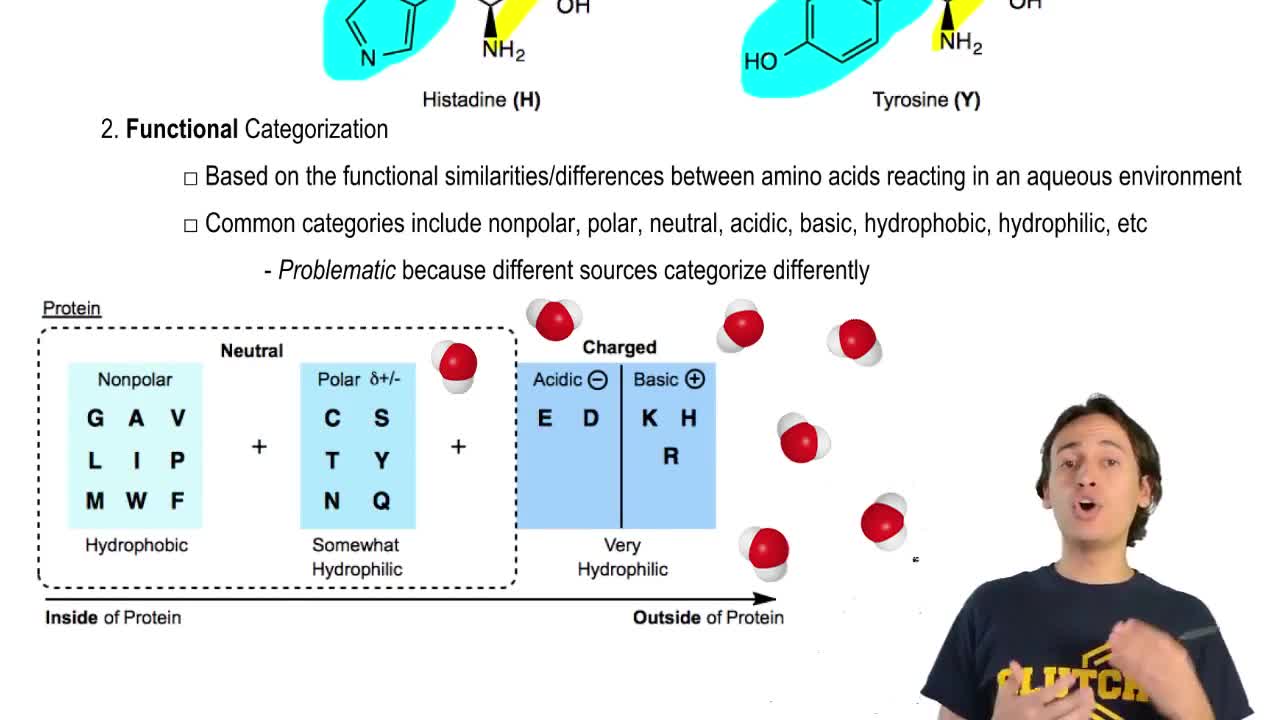
Functional Classification

Hydrogen Bonding

Hydrogen bonding is a type of attractive interaction that occurs between a hydrogen atom bonded to a highly electronegative atom (like oxygen or nitrogen) and another electronegative atom. This interaction significantly increases the solubility of a molecule in water, as it allows for the formation of strong attractions between the solute and solvent molecules, facilitating dissolution.
추천 영상:
00:48
The definition of hydrogenation.

Molecular Structure

The molecular structure of a compound, including its functional groups and overall shape, plays a crucial role in its solubility. For instance, the presence of hydroxyl (-OH) groups can enhance water solubility due to their ability to form hydrogen bonds. Conversely, large hydrophobic regions can hinder solubility in water, making it essential to analyze the structural features of molecules A and B to understand their differing solubility.
추천 영상:
08:41
Review of Molecular Orbitals