Molecule A is significantly more water soluble than molecule B. Justify this observation.
Ch. 23 - Benzene 1: Aromatic Stability and Substitution Reactions

Mullins1st EditionOrganic Chemistry: A Learner Centered ApproachISBN: 9780137566471당신이 사용하는 게 아니라요?교과서 변경
22장, 문제 72a
Predict the major product(s) that would result when molecules (a)–(i) are allowed to react under the following conditions. (iv) chlorocyclopentane, AlCl3, (v) 1-chloro-1-methylcyclohexane , AlCl3, (vi) PhCOCl, AlCl3. If no reaction will occur, indicate by writing NR.
(a) 
검증된 단계별 안내1
Identify the type of reaction: The presence of AlCl3 suggests a Friedel-Crafts reaction, which is a type of electrophilic aromatic substitution.
Analyze the reactants: The image shows a benzene ring, which is a common substrate for Friedel-Crafts reactions.
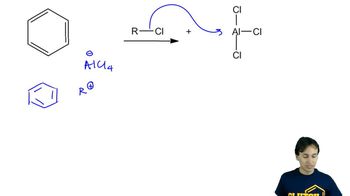
Consider the electrophile: In the case of chlorocyclopentane with AlCl3, the electrophile is a cyclopentyl cation formed by the interaction of chlorocyclopentane with AlCl3.
Predict the reaction: The cyclopentyl cation will attack the benzene ring, leading to the formation of a cyclopentylbenzene product.
Evaluate the conditions: Ensure that the reaction conditions are suitable for the Friedel-Crafts alkylation to occur, such as the presence of a strong Lewis acid (AlCl3) and an aromatic substrate (benzene).

비슷한 문제에 대한 검증된 영상 답변:
이 영상 해법은 위 문제에 도움이 된다고 튜터들이 추천한 것입니다.
주요 개념
질문에 올바르게 답하기 위해 반드시 이해해야 하는 핵심 개념들은 다음과 같습니다.
Friedel-Crafts Alkylation
Friedel-Crafts alkylation is a reaction that introduces an alkyl group into an aromatic ring using an alkyl halide and a Lewis acid catalyst like AlCl3. The catalyst helps generate a carbocation from the alkyl halide, which then attacks the electron-rich aromatic ring, forming a new carbon-carbon bond. This reaction is useful for synthesizing alkylbenzenes but can lead to polyalkylation and carbocation rearrangements.
추천 영상:
Friedel-Crafts Alkylation
Friedel-Crafts Acylation
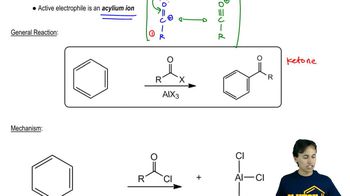
Friedel-Crafts acylation involves the introduction of an acyl group into an aromatic ring using an acyl chloride and a Lewis acid catalyst such as AlCl3. This reaction forms a ketone and is generally more controlled than alkylation, as it avoids carbocation rearrangements and polyacylation. The acylium ion, generated in situ, is the electrophile that attacks the aromatic ring, leading to the formation of an aryl ketone.
추천 영상:
Friedel-Crafts Acylation
Aromaticity and Electrophilic Aromatic Substitution
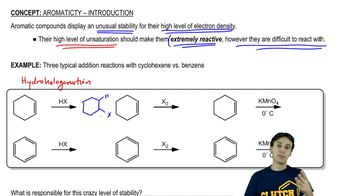
Aromatic compounds, like benzene, are characterized by their stability due to delocalized π-electrons. Electrophilic aromatic substitution (EAS) is a common reaction mechanism where an electrophile replaces a hydrogen atom on the aromatic ring. The stability of the aromatic system is temporarily disrupted during the formation of a sigma complex, but restored upon re-aromatization. Understanding EAS is crucial for predicting the outcome of reactions involving aromatic compounds.
추천 영상:
Intro to Aromaticity
관련 실천
교과서 질문
849
views
교과서 질문
Protonation of aniline slows electrophilic aromatic substitution and directs electrophiles to the meta position. Why?
916
views
교과서 질문
Despite having only sp2-hybridized carbons and having 10 electrons (4n + 2) , the annulene shown is not aromatic. Why?
705
views
교과서 질문
In Section 17.7.4, we studied the acid-catalyzed hydrolysis of acetals. The acetal shown here resists hydrolysis by the mechanism in Figure 17.63. Why? [Draw the intermediates as if the reaction would occur, then analyze the intermediates for any problems.]
534
views
교과서 질문
Suggest a synthesis of each of the molecules shown beginning with benzene.
(c)
496
views
교과서 질문
Bromination of phenol or aniline does not require the use of a Lewis acid catalyst and often results in trihalogenation. Why?
837
views