Ch. 26 - Amino Acids, Proteins, and Peptide Synthesis
Mullins - Organic Chemistry: A Learner Centered Approach 1st Edition
Mullins1st EditionOrganic Chemistry: A Learner Centered ApproachISBN: 9780137566471당신이 사용하는 게 아니라요?교과서 변경
25장, 문제 5

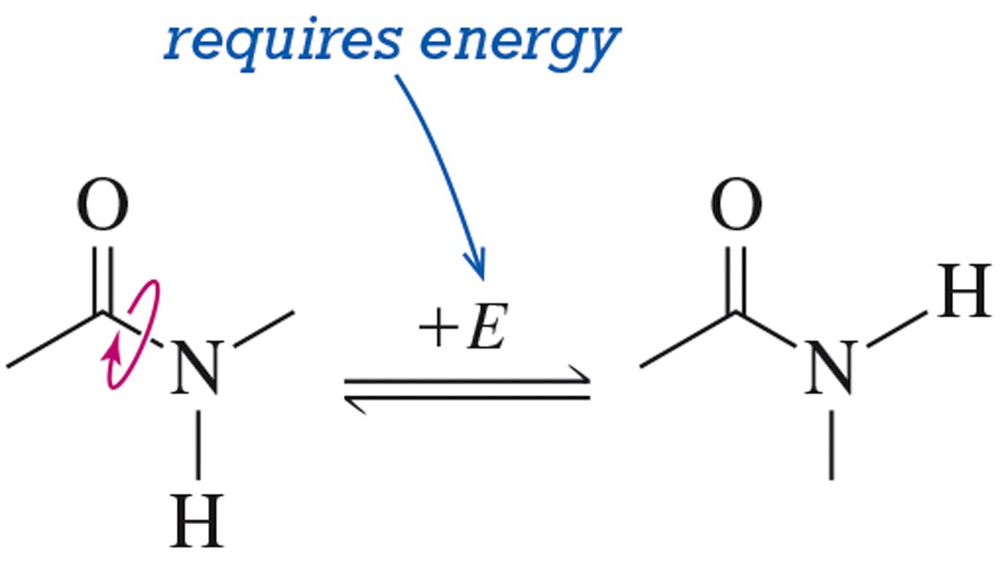
Although there is free rotation around most σ bonds, rotation is restricted around the C--N bond of an amide. Explain why this is true.

검증된 단계별 안내
1
Understand the structure of an amide group: An amide consists of a carbonyl group (C=O) directly bonded to a nitrogen atom (N). The bond in question is the C--N bond within the amide functional group.
Recognize the concept of resonance: In an amide, the lone pair of electrons on the nitrogen can delocalize into the carbonyl group, forming a resonance structure. This resonance creates a partial double bond character between the carbon and nitrogen atoms.
Explain the impact of resonance: The partial double bond character restricts rotation around the C--N bond because double bonds do not allow free rotation due to the overlap of π orbitals. Rotating the bond would disrupt the π orbital overlap and destabilize the molecule.
Discuss the energy barrier: The restricted rotation around the C--N bond is due to the high energy barrier required to break the π orbital overlap and allow rotation. This makes the bond effectively rigid in most conditions.
Conclude with the significance: The restricted rotation around the C--N bond in amides is a key feature that influences the geometry and properties of amide-containing molecules, such as proteins and peptides.

비슷한 문제에 대한 검증된 영상 답변:

이 영상 해법은 위 문제에 도움이 된다고 튜터들이 추천한 것입니다.
영상 길이:
2m

주요 개념

질문에 올바르게 답하기 위해 반드시 이해해야 하는 핵심 개념들은 다음과 같습니다.

σ Bonds and Free Rotation

σ (sigma) bonds are formed by the head-on overlap of atomic orbitals, allowing for free rotation around the bond axis under normal circumstances. This rotation is generally unrestricted in single bonds, enabling the connected atoms to adopt various spatial arrangements without significant energy barriers.
추천 영상:
06:00
Single bonds, double bonds, and triple bonds.

Amide Structure and Resonance

Amides contain a carbonyl group (C=O) directly bonded to a nitrogen atom (N). The presence of resonance in amides, where the lone pair on nitrogen can delocalize into the carbonyl, creates a partial double bond character in the C--N bond. This resonance stabilizes the amide but restricts rotation due to the increased energy required to break the partial double bond character.
추천 영상:
03:04
Drawing Resonance Structures

Steric Hindrance and Conformational Stability

Steric hindrance refers to the repulsion between atoms that occurs when they are brought close together, which can affect molecular conformation. In amides, bulky substituents on the nitrogen or adjacent carbon can create steric clashes that further inhibit rotation around the C--N bond, leading to a preference for specific conformations that minimize these interactions.
추천 영상:
03:29
Understanding what a conformer is.