Ch. 4 - Acids and Bases/Electron Flow
Mullins - Organic Chemistry: A Learner Centered Approach 1st Edition
Mullins1st EditionOrganic Chemistry: A Learner Centered ApproachISBN: 9780137566471당신이 사용하는 게 아니라요?교과서 변경
3장, 문제 25a

An unknown acid (HA) has been identified as very strong. What does this tell you about the stability of the conjugate base, A⁻? Is it strong or weak? Is it reactive or unreactive?

검증된 단계별 안내
1
Understand the relationship between acid strength and conjugate base stability: A strong acid (HA) dissociates completely in water, meaning it donates its proton (H⁺) readily. This implies that its conjugate base (A⁻) must be very stable, as it does not readily reaccept the proton.
Recall the principle of conjugate acid-base pairs: The stronger the acid, the weaker its conjugate base. Since HA is identified as a very strong acid, its conjugate base (A⁻) is weak.
Analyze the reactivity of the conjugate base: A weak conjugate base is typically unreactive because it is stable and does not have a strong tendency to gain a proton or participate in other chemical reactions.
Consider the implications for chemical behavior: The stability of A⁻ means it is less likely to interfere in reactions or act as a nucleophile, making it unreactive in most contexts.
Summarize the findings: The conjugate base (A⁻) of a very strong acid (HA) is weak and unreactive due to its high stability.

비슷한 문제에 대한 검증된 영상 답변:

이 영상 해법은 위 문제에 도움이 된다고 튜터들이 추천한 것입니다.

주요 개념

질문에 올바르게 답하기 위해 반드시 이해해야 하는 핵심 개념들은 다음과 같습니다.

Acid-Base Theory

Acid-base theory explains the behavior of acids and bases in terms of proton transfer. A strong acid, like the unknown acid HA, completely dissociates in solution, releasing protons (H⁺) and forming its conjugate base (A⁻). The strength of an acid is inversely related to the strength of its conjugate base; thus, a very strong acid indicates that its conjugate base is weak.
추천 영상:
02:49
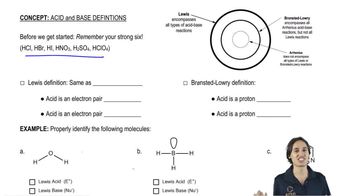
The Lewis definition of acids and bases.

Conjugate Base Stability

The stability of a conjugate base is crucial in determining the strength of its corresponding acid. A stable conjugate base (A⁻) is less likely to re-accept a proton, making the acid stronger. Factors influencing stability include electronegativity, resonance, and inductive effects; a weak conjugate base typically has lower stability, which aligns with the strong nature of the original acid.
추천 영상:
04:31
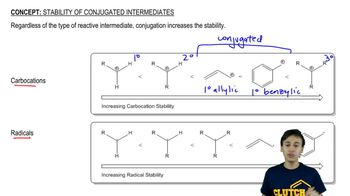
Stability of Conjugated Intermediates

Reactivity of Conjugate Bases

The reactivity of a conjugate base is often linked to its stability. A weak conjugate base, such as A⁻ from a strong acid, is generally unreactive because it does not readily accept protons. This unreactivity stems from its stability, meaning it is less likely to participate in further acid-base reactions, contrasting with strong conjugate bases that are more reactive.
추천 영상:
05:29
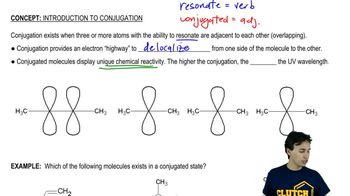
Definition of Conjugation