Ch. 4 - Acids and Bases/Electron Flow
Mullins - Organic Chemistry: A Learner Centered Approach 1st Edition
Mullins1st EditionOrganic Chemistry: A Learner Centered ApproachISBN: 9780137566471당신이 사용하는 게 아니라요?교과서 변경
3장, 문제 29

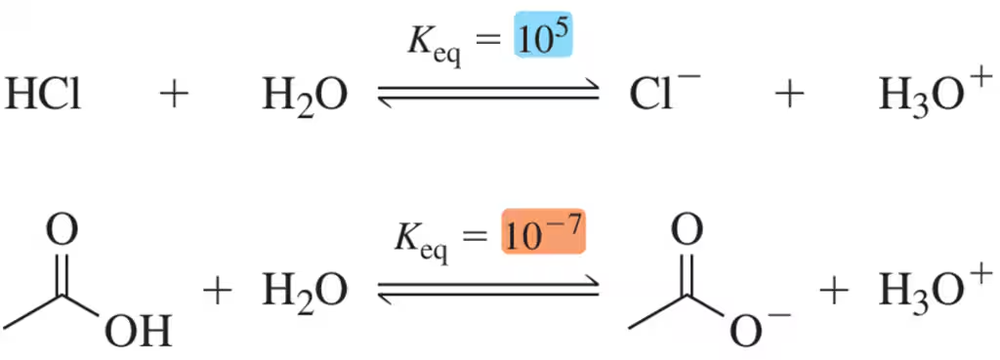
Given the following Keq values, how much stronger of a base is acetate (CH3CO2-) than chloride (Cl⁻)?
Chemical equilibrium reactions showing K_eq values for HCl and acetate, comparing their strengths as acids and bases.

검증된 단계별 안내
1
Step 1: Understand the relationship between K_eq and base strength. The equilibrium constant (K_eq) is related to the acid dissociation constant (K_a) of the conjugate acids. A stronger base corresponds to a weaker conjugate acid, which has a smaller K_a value.
Step 2: Identify the conjugate acids of the bases in question. Acetate (CH₃CO⁻₂) is the conjugate base of acetic acid (CH₃COOH), and chloride (Cl⁻) is the conjugate base of hydrochloric acid (HCl).
Step 3: Use the formula K_a = K_eq for the dissociation of the conjugate acid. Compare the K_a values of acetic acid and hydrochloric acid to determine the relative base strength of acetate and chloride.
Step 4: Calculate the ratio of the K_a values. The relative base strength can be determined by comparing the inverse of the K_a values (since base strength is inversely proportional to acid strength). Use the formula: \( \text{Relative base strength} = \frac{K_{a, \text{HCl}}}{K_{a, \text{CH₃COOH}}} \).
Step 5: Interpret the result. The larger the ratio, the stronger acetate is as a base compared to chloride. This ratio quantifies how much stronger acetate is as a base than chloride.

비슷한 문제에 대한 검증된 영상 답변:

이 영상 해법은 위 문제에 도움이 된다고 튜터들이 추천한 것입니다.
영상 길이:
4m

주요 개념

질문에 올바르게 답하기 위해 반드시 이해해야 하는 핵심 개념들은 다음과 같습니다.

Equilibrium Constant (K_eq)

The equilibrium constant (K_eq) quantifies the ratio of the concentrations of products to reactants at equilibrium for a reversible reaction. A higher K_eq value indicates that the products are favored, suggesting a stronger tendency for the reaction to proceed in that direction. In the context of acids and bases, K_eq can help determine the relative strengths of different bases.
추천 영상:
02:19
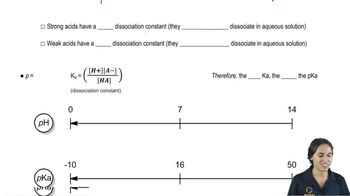
The relationship between equilibrium constant and pKa.

Acidity and Basicity

Acidity refers to the tendency of a substance to donate protons (H⁺), while basicity refers to the ability to accept protons. The strength of a base can be inferred from the K_eq of its conjugate acid; a stronger base corresponds to a weaker conjugate acid. Understanding the relationship between acids and bases is crucial for comparing the basicity of acetate and chloride.
추천 영상:
06:21
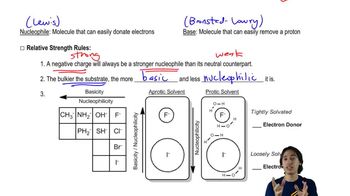
Understanding the difference between basicity and nucleophilicity.

Conjugate Acid-Base Pairs

Conjugate acid-base pairs consist of two species that differ by the presence of a proton. For example, acetate (CH₃CO⁻₂) is the conjugate base of acetic acid (CH₃COOH), while chloride (Cl⁻) is the conjugate base of hydrochloric acid (HCl). The strength of the conjugate acids can be compared using their K_a values, which directly influences the basicity of their corresponding bases.
추천 영상:
가이드 코스
2:56
Base Pairing Concept 1