Ch. 4 - Acids and Bases/Electron Flow
Mullins - Organic Chemistry: A Learner Centered Approach 1st Edition
Mullins1st EditionOrganic Chemistry: A Learner Centered ApproachISBN: 9780137566471당신이 사용하는 게 아니라요?교과서 변경
3장, 문제 39d

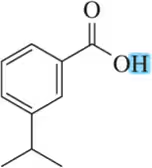
For each indicated proton, suggest an approximate pKa value from Table 4.5. Rationalize your choice.
(d) Chemical structure of a phenolic compound with a hydroxyl group highlighted, indicating its acidic proton for pKa analysis.

검증된 단계별 안내
1
Identify the functional group or type of proton in the molecule. For example, determine if the proton is part of an alcohol (-OH), carboxylic acid (-COOH), amine (-NH₂), or other functional group.
Refer to Table 4.5 (or a similar pKₐ reference table) to find the typical pKₐ range for the functional group or type of proton identified in the previous step.
Consider the molecular environment around the proton. For example, assess whether there are electron-withdrawing or electron-donating groups nearby, as these can influence the acidity and shift the pKₐ value.
Rationalize your choice by explaining how the molecular structure and substituents affect the proton's acidity. For instance, electron-withdrawing groups stabilize the conjugate base, lowering the pKₐ, while electron-donating groups have the opposite effect.
Assign an approximate pKₐ value based on the functional group and the specific molecular context, ensuring it aligns with the trends observed in the reference table.

비슷한 문제에 대한 검증된 영상 답변:

이 영상 해법은 위 문제에 도움이 된다고 튜터들이 추천한 것입니다.
영상 길이:
2m
도움이 되었나요?

주요 개념

질문에 올바르게 답하기 위해 반드시 이해해야 하는 핵심 개념들은 다음과 같습니다.

pKₐ and Acid-Base Strength

pKₐ is a quantitative measure of the strength of an acid in solution. It is the negative logarithm of the acid dissociation constant (Kₐ), with lower pKₐ values indicating stronger acids. Understanding pKₐ is essential for predicting the behavior of protons in various chemical environments, as it helps determine the likelihood of proton donation.
추천 영상:
가이드 코스
2:50
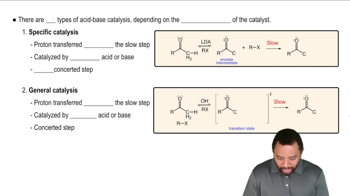
Acid-Base Catalysis Concept 3

Protonation and Deprotonation

Protonation refers to the addition of a proton (H⁺) to a molecule, while deprotonation is the removal of a proton. The pKₐ value of a proton indicates the equilibrium position of these processes. Knowing which protons are likely to be protonated or deprotonated under specific conditions is crucial for rationalizing pKₐ values.
추천 영상:
03:
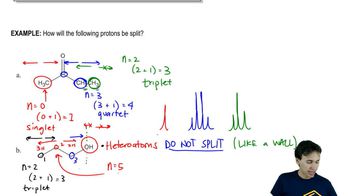
Proton Splitting

Contextual Factors Influencing pKₐ

The pKₐ of a proton can be influenced by various factors, including the molecular structure, electronegativity of nearby atoms, and solvent effects. For example, electron-withdrawing groups can stabilize the negative charge of the conjugate base, leading to a lower pKₐ. Understanding these contextual factors is vital for accurately estimating pKₐ values from tables.
추천 영상:
00:57
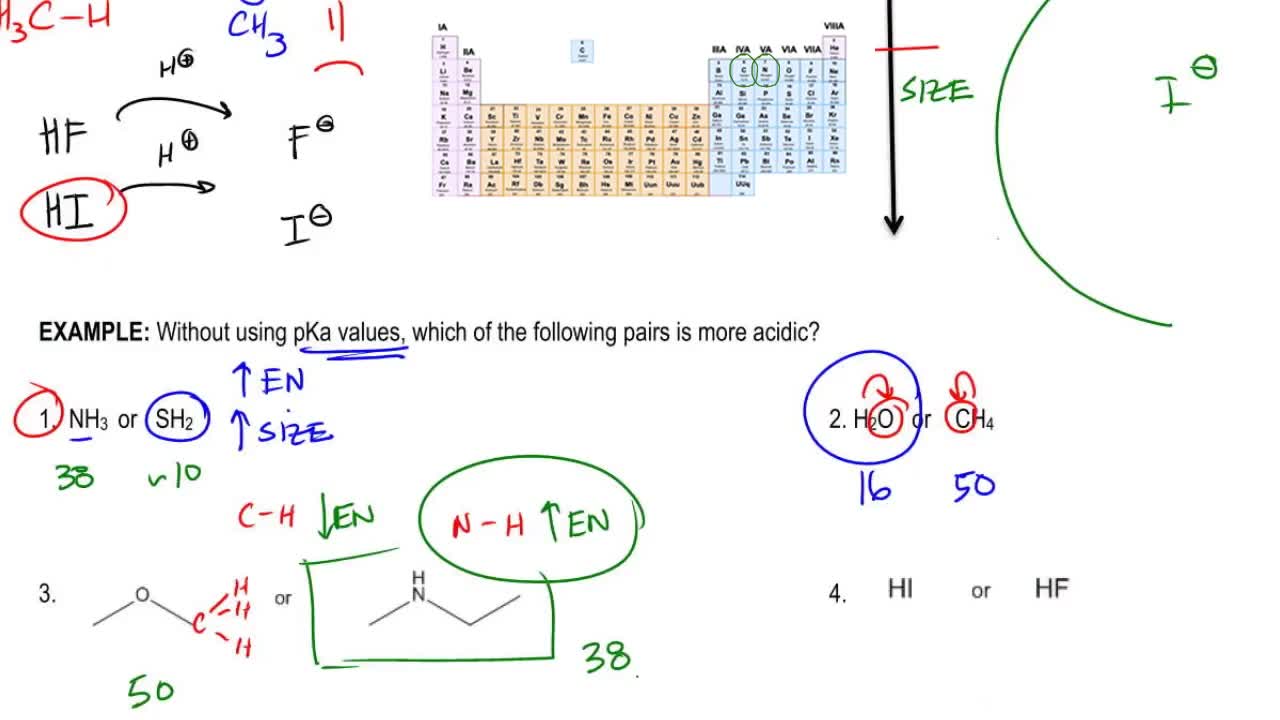
Using factors affecting acidity to rank acids