Ch. 4 - Acids and Bases/Electron Flow
Mullins - Organic Chemistry: A Learner Centered Approach 1st Edition
Mullins1st EditionOrganic Chemistry: A Learner Centered ApproachISBN: 9780137566471당신이 사용하는 게 아니라요?교과서 변경
3장, 문제 40d

For the bases shown, draw the conjugate acid and identify a pKa value from Table 4.5 that would help you accurately estimate its stability.
(d)

검증된 단계별 안내
1
Step 1: Identify the base shown in the image. The structure represents an isopropyl anion (CH₃)₂CH⁻, which is a negatively charged carbon atom bonded to two methyl groups and one hydrogen atom.
Step 2: To draw the conjugate acid, add a proton (H⁺) to the base. This will neutralize the negative charge on the carbon atom, resulting in isopropane (CH₃)₂CH₂.
Step 3: Recall that the conjugate acid of a base has a pKₐ value that reflects its acidity. The pKₐ value can be found in Table 4.5, which lists the pKₐ values of common acids. For isopropane, the pKₐ of its conjugate acid is approximately 50, indicating it is a very weak acid.
Step 4: Use the pKₐ value to estimate the stability of the base. A high pKₐ value (like 50) suggests that the conjugate acid is very stable, and the base (isopropyl anion) is relatively unstable.
Step 5: Summarize the findings: The conjugate acid of the isopropyl anion is isopropane, and its pKₐ value of approximately 50 indicates that the base is unstable and the conjugate acid is highly stable.

비슷한 문제에 대한 검증된 영상 답변:

이 영상 해법은 위 문제에 도움이 된다고 튜터들이 추천한 것입니다.
영상 길이:
4m

주요 개념

질문에 올바르게 답하기 위해 반드시 이해해야 하는 핵심 개념들은 다음과 같습니다.

Conjugate Acids and Bases

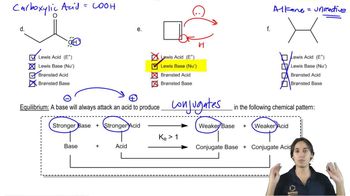
In acid-base chemistry, a conjugate acid is formed when a base accepts a proton (H⁺). Understanding this concept is crucial for predicting the behavior of substances in reactions. For example, when ammonia (NH₃) acts as a base, it can accept a proton to form its conjugate acid, ammonium (NH₄⁺). This relationship helps in determining the strength of acids and bases.
추천 영상:
02:11
Equilibrium constant and conjugates.

pKₐ and Acid Strength

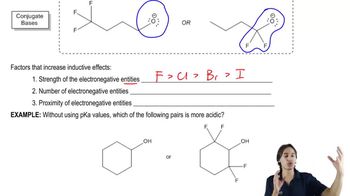
pKₐ is a quantitative measure of the strength of an acid in solution, with lower values indicating stronger acids. It is derived from the acid dissociation constant (Kₐ), which reflects the extent to which an acid donates protons. Understanding pKₐ values is essential for comparing the stability of conjugate acids and bases, as they provide insight into the equilibrium position of acid-base reactions.
추천 영상:
03:09
The 3 factors that determine the strength of inductive effects.

Stability of Conjugate Acids

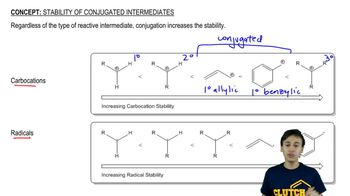
The stability of a conjugate acid is influenced by factors such as electronegativity, resonance, and inductive effects. A more stable conjugate acid corresponds to a weaker base, as it is less likely to donate a proton. Evaluating the stability of conjugate acids helps in predicting the direction of acid-base reactions and understanding the relative strengths of the corresponding bases.
추천 영상:
04:31
Stability of Conjugated Intermediates