Ch. 4 - Acids and Bases/Electron Flow
Mullins - Organic Chemistry: A Learner Centered Approach 1st Edition
Mullins1st EditionOrganic Chemistry: A Learner Centered ApproachISBN: 9780137566471당신이 사용하는 게 아니라요?교과서 변경
3장, 문제 51f

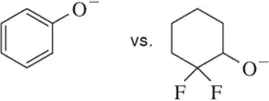
Identify the most stable conjugate base in each pair. Tell which structural features you analyzed and why you weighted them as you did in picking one answer.
(f) Comparison of two conjugate bases: a phenoxide ion and a fluorinated cyclohexanol ion, highlighting acidity stability.

검증된 단계별 안내
1
Step 1: Analyze the resonance stabilization of the conjugate bases. The conjugate base on the left (phenoxide ion) has the negative charge on the oxygen atom delocalized into the aromatic ring through resonance. This delocalization spreads the charge over multiple atoms, increasing stability. The conjugate base on the right does not have resonance stabilization, as the negative charge remains localized on the oxygen atom.
Step 2: Evaluate the inductive effects. In the conjugate base on the right, the two fluorine atoms exert a strong electron-withdrawing inductive effect due to their high electronegativity. This effect stabilizes the negative charge on the oxygen atom by pulling electron density away from it. The conjugate base on the left does not have such electron-withdrawing groups.
Step 3: Compare the overall stabilization. Resonance effects generally provide greater stabilization than inductive effects because resonance spreads the charge over multiple atoms, whereas inductive effects only reduce electron density locally. Therefore, the conjugate base on the left is likely more stable due to resonance.
Step 4: Consider the hybridization of the atoms involved. In the conjugate base on the left, the oxygen atom is attached to an sp2-hybridized carbon in the aromatic ring, which allows for effective overlap and resonance. In the conjugate base on the right, the oxygen atom is attached to an sp3-hybridized carbon, which does not participate in resonance.
Step 5: Conclude based on the structural features analyzed. The phenoxide ion (left structure) is the most stable conjugate base due to the significant resonance stabilization, which outweighs the inductive effects provided by the fluorine atoms in the right structure.

비슷한 문제에 대한 검증된 영상 답변:

이 영상 해법은 위 문제에 도움이 된다고 튜터들이 추천한 것입니다.
도움이 되었나요?

주요 개념

질문에 올바르게 답하기 위해 반드시 이해해야 하는 핵심 개념들은 다음과 같습니다.

Conjugate Bases

A conjugate base is the species that remains after an acid donates a proton (H+). The stability of a conjugate base is crucial in determining the strength of its corresponding acid. A more stable conjugate base indicates a stronger acid, as it can better accommodate the negative charge resulting from deprotonation.
추천 영상:
03:27
Conjugated states

Resonance Stabilization

Resonance stabilization occurs when a molecule can be represented by multiple valid Lewis structures, allowing for the delocalization of electrons. In the case of the phenoxide ion, the negative charge on the oxygen can be delocalized into the aromatic ring, enhancing its stability compared to a conjugate base that lacks such resonance, like the fluorinated cyclohexanol ion.
추천 영상:
03:43
The radical stability trend.

Inductive Effect

The inductive effect refers to the electron-withdrawing or electron-donating effects of substituents on a molecule. In the fluorinated cyclohexanol ion, the electronegative fluorine atoms can stabilize the negative charge through an inductive effect, but this effect is generally weaker than resonance stabilization. Thus, while inductive effects play a role, they may not outweigh the resonance stabilization present in the phenoxide ion.
추천 영상:
01:47
Understanding the Inductive Effect.