Ch. 4 - Acids and Bases/Electron Flow
Mullins - Organic Chemistry: A Learner Centered Approach 1st Edition
Mullins1st EditionOrganic Chemistry: A Learner Centered ApproachISBN: 9780137566471당신이 사용하는 게 아니라요?교과서 변경
3장, 문제 52b

Identify the most acidic proton in each pair. Tell which structural features you analyzed and why you weighted them as you did in picking one answer. [Always start by drawing the conjugate base.]
(b)

검증된 단계별 안내
1
Step 1: Begin by drawing the conjugate base for each molecule. For the thiol (CH3CH2SH), remove the proton from the sulfur atom to form CH3CH2S⁻. For the amide (CH3CONH2), remove the proton from the nitrogen atom to form CH3CONH⁻.
Step 2: Analyze the stability of each conjugate base. The stability of a conjugate base is a key factor in determining the acidity of the proton. A more stable conjugate base corresponds to a more acidic proton.
Step 3: Consider electronegativity. Sulfur is less electronegative than nitrogen, meaning the negative charge on CH3CH2S⁻ is less stabilized compared to CH3CONH⁻. This suggests that the proton on the thiol group is less acidic than the proton on the amide group.
Step 4: Evaluate resonance effects. The conjugate base of the amide (CH3CONH⁻) benefits from resonance stabilization, as the negative charge can delocalize onto the oxygen atom in the carbonyl group. This resonance stabilization makes the proton on the amide more acidic.
Step 5: Consider inductive effects. The carbonyl group in the amide exerts an electron-withdrawing effect, further stabilizing the conjugate base (CH3CONH⁻). This additional stabilization reinforces the conclusion that the proton on the amide is more acidic than the proton on the thiol.

비슷한 문제에 대한 검증된 영상 답변:

이 영상 해법은 위 문제에 도움이 된다고 튜터들이 추천한 것입니다.
도움이 되었나요?

주요 개념

질문에 올바르게 답하기 위해 반드시 이해해야 하는 핵심 개념들은 다음과 같습니다.

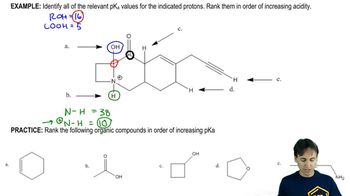
Acidity and pKa

Acidity in organic chemistry refers to the tendency of a compound to donate a proton (H+). The strength of an acid is often measured by its pKa value; lower pKa values indicate stronger acids. Understanding the relationship between acidity and pKa is crucial for identifying the most acidic proton in a given structure.
추천 영상:
07:45
Identifying pKa values

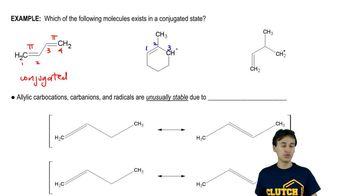
Conjugate Bases

When an acid donates a proton, it forms a conjugate base. The stability of this conjugate base significantly influences the acidity of the original compound. Analyzing the conjugate base helps determine which proton is more acidic, as a more stable conjugate base corresponds to a stronger acid.
추천 영상:
03:27
Conjugated states

Resonance and Inductive Effects

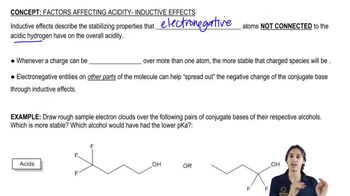
Resonance refers to the delocalization of electrons across multiple atoms, which can stabilize a conjugate base and enhance acidity. Inductive effects involve the influence of electronegative atoms or groups that can withdraw electron density, further stabilizing the conjugate base. Both effects are essential in evaluating the acidity of protons in organic molecules.
추천 영상:
01:47
Understanding the Inductive Effect.