Ch. 4 - Acids and Bases/Electron Flow
Mullins - Organic Chemistry: A Learner Centered Approach 1st Edition
Mullins1st EditionOrganic Chemistry: A Learner Centered ApproachISBN: 9780137566471당신이 사용하는 게 아니라요?교과서 변경
3장, 문제 18c

Provide an arrow-pushing mechanism for the following acid–base reactions.
(c) Arrow-pushing mechanism illustrating acid-base reactions with reactants and products shown as structural formulas.

검증된 단계별 안내
1
Identify the acid and base in the reaction. The acid is the species donating a proton (H⁺), and the base is the species accepting the proton.
Draw the Lewis structures of the acid and base to clearly show the lone pairs and bonds involved in the reaction.
Use curved arrows to represent the movement of electrons. Start the arrow at the lone pair of the base (nucleophile) and point it toward the hydrogen atom of the acid.
Show the bond between the hydrogen and the acid breaking. Use a curved arrow starting from the bond and pointing toward the atom that will retain the electrons after the bond breaks (usually the conjugate base of the acid).
Draw the products of the reaction, including the conjugate acid (formed by the base after gaining a proton) and the conjugate base (formed by the acid after losing a proton). Ensure all charges and lone pairs are correctly assigned.

비슷한 문제에 대한 검증된 영상 답변:

이 영상 해법은 위 문제에 도움이 된다고 튜터들이 추천한 것입니다.
영상 길이:
1m

주요 개념

질문에 올바르게 답하기 위해 반드시 이해해야 하는 핵심 개념들은 다음과 같습니다.

Acid-Base Theory

Acid-base theory explains the behavior of acids and bases in chemical reactions. According to the Brønsted-Lowry theory, acids are proton donors while bases are proton acceptors. Understanding this concept is crucial for predicting the direction of acid-base reactions and identifying the reactants and products involved.
추천 영상:
02:49
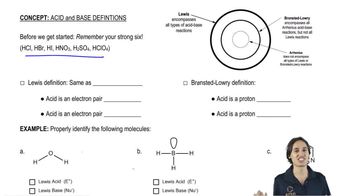
The Lewis definition of acids and bases.

Arrow-Pushing Mechanism

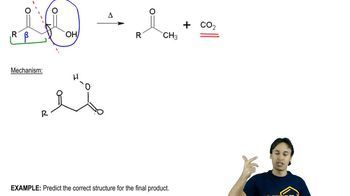
The arrow-pushing mechanism is a visual representation used to illustrate the movement of electrons during chemical reactions. In acid-base reactions, arrows indicate the transfer of protons and the flow of electron pairs, helping to clarify how reactants transform into products. Mastery of this technique is essential for accurately depicting reaction pathways.
추천 영상:
04:32
General Mechanism

Reaction Intermediates

Reaction intermediates are transient species formed during the conversion of reactants to products in a chemical reaction. In acid-base reactions, intermediates can include protonated or deprotonated species that play a critical role in the reaction mechanism. Recognizing these intermediates aids in understanding the overall process and predicting the stability of the final products.
추천 영상:
04:31
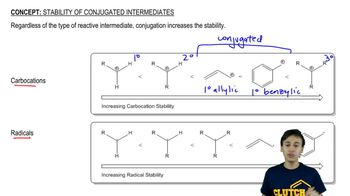
Stability of Conjugated Intermediates