Ch. 4 - Acids and Bases/Electron Flow
Mullins - Organic Chemistry: A Learner Centered Approach 1st Edition
Mullins1st EditionOrganic Chemistry: A Learner Centered ApproachISBN: 9780137566471당신이 사용하는 게 아니라요?교과서 변경
3장, 문제 61h

Would you expect the following species to be electrophiles or nucleophiles? Some may be both. Explain your answer.
(h) Chemical structure of a nitrogen atom with three attached groups, illustrating potential electrophilic and nucleophilic behavior.

검증된 단계별 안내
1
Step 1: Understand the definitions of electrophiles and nucleophiles. Electrophiles are species that are electron-deficient and seek electrons, often having a positive charge or a partial positive charge. Nucleophiles are species that are electron-rich and donate electrons, often having a negative charge, lone pairs, or π-electrons.
Step 2: Analyze the given species (h) to determine its electronic structure. Look for features such as lone pairs, π-bonds, or charges that indicate nucleophilic behavior, or electron-deficient centers that indicate electrophilic behavior.
Step 3: Consider resonance effects, inductive effects, and the presence of electronegative atoms. These factors can influence whether the species acts as an electrophile, nucleophile, or both. For example, resonance can delocalize charges, making a species more stable and potentially altering its reactivity.
Step 4: Evaluate the hybridization and geometry of the species. For instance, sp2 or sp hybridized carbons in certain contexts can act as electrophiles, while lone pairs on heteroatoms like oxygen or nitrogen can make them nucleophiles.
Step 5: Conclude whether the species is an electrophile, nucleophile, or both based on the analysis. Provide reasoning for your conclusion, such as the presence of electron-rich or electron-deficient regions, and how these regions interact with other molecules in a reaction.

비슷한 문제에 대한 검증된 영상 답변:

이 영상 해법은 위 문제에 도움이 된다고 튜터들이 추천한 것입니다.
영상 길이:
3m

주요 개념

질문에 올바르게 답하기 위해 반드시 이해해야 하는 핵심 개념들은 다음과 같습니다.

Electrophiles

Electrophiles are species that are electron-deficient and seek to gain electrons to achieve a more stable electronic configuration. They typically have a positive charge or a partial positive charge, making them attractive to nucleophiles, which are electron-rich species. Common examples include carbocations and carbonyl compounds, which can react with nucleophiles to form new bonds.
추천 영상:
03:
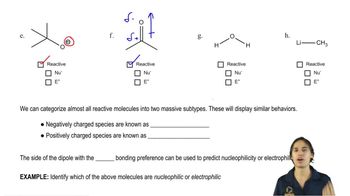
Nucleophile or Electrophile

Nucleophiles

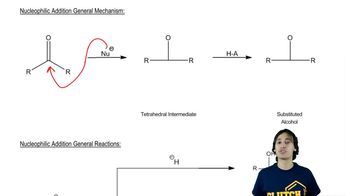
Nucleophiles are species that are electron-rich and can donate a pair of electrons to form a new covalent bond. They often possess a negative charge or have lone pairs of electrons available for bonding. Examples include anions like hydroxide (OH-) and neutral molecules like ammonia (NH3), which can react with electrophiles to create stable products.
추천 영상:
08:27
Nucleophilic Addition

Dual Reactivity

Some species can act as both electrophiles and nucleophiles depending on the reaction conditions and the nature of the other reactants involved. This dual reactivity is often seen in compounds with both electron-withdrawing and electron-donating groups. Understanding the context of the reaction is crucial to predicting the behavior of such species in organic reactions.
추천 영상:
01:17
Reactivity of Molecules