Ch. 8 - Alkenes 1: Properties and Electrophilic Additions
Mullins - Organic Chemistry: A Learner Centered Approach 1st Edition
Mullins1st EditionOrganic Chemistry: A Learner Centered ApproachISBN: 9780137566471당신이 사용하는 게 아니라요?교과서 변경
7장, 문제 53a

Oxymercuration–reduction, like acid-catalyzed hydration, can be modified to synthesize ethers. Suggest an alkene and the appropriate reaction conditions to synthesize the following ethers.
(a) Chemical structure of an ether with a phenyl group, an oxygen atom, and an isopropyl group.

검증된 단계별 안내
1
Identify the target ether structure and determine the position of the oxygen atom in the final product. This will help in identifying the alkene and the alcohol needed for the reaction.
Select an alkene that, upon oxymercuration, will lead to the formation of a carbocation at the position where the ether linkage is desired. This is typically the more substituted carbon of the double bond.
Choose the appropriate alcohol that will act as the nucleophile in the reaction. The alcohol will attack the carbocation formed during the oxymercuration step, leading to the formation of the ether linkage.
Set up the reaction conditions for oxymercuration. This typically involves using mercuric acetate (Hg(OAc)2) in a solvent like THF (tetrahydrofuran) with the chosen alcohol. This step forms the mercurinium ion intermediate.
Perform the reduction step using sodium borohydride (NaBH4) in a basic aqueous solution. This step will remove the mercury group and complete the formation of the ether product.

비슷한 문제에 대한 검증된 영상 답변:

이 영상 해법은 위 문제에 도움이 된다고 튜터들이 추천한 것입니다.
영상 길이:
2m
도움이 되었나요?

주요 개념

질문에 올바르게 답하기 위해 반드시 이해해야 하는 핵심 개념들은 다음과 같습니다.

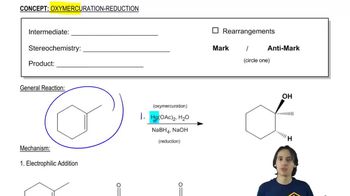
Oxymercuration–Reduction

Oxymercuration–reduction is a two-step reaction used to convert alkenes into alcohols or ethers without carbocation rearrangement. The first step involves the addition of mercuric acetate to the alkene, forming a mercurinium ion intermediate. In the second step, sodium borohydride (NaBH4) reduces the intermediate, replacing the mercury with a hydrogen atom, resulting in the formation of an alcohol or ether.
추천 영상:
05:
General properties of oxymercuration-reduction.

Alkene Selection

Choosing the correct alkene is crucial for synthesizing the desired ether. The alkene's structure determines the position where the ether linkage will form. Typically, the alkene should have a double bond at the location where the ether's oxygen will be introduced, ensuring the correct regioselectivity and stereochemistry in the final product.
추천 영상:
가이드 코스
2:09
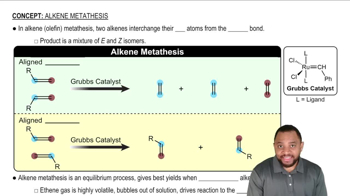
Alkene Metathesis Concept 1

Reaction Conditions for Ether Synthesis

To synthesize ethers using oxymercuration–reduction, the reaction conditions must be carefully controlled. The process involves using an alcohol as a nucleophile instead of water in the oxymercuration step. This modification allows the formation of an ether linkage instead of an alcohol, with the alcohol's oxygen attacking the mercurinium ion, leading to the desired ether product after reduction.
추천 영상:
03:50
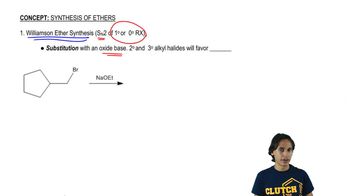
The Mechanism of Williamson Ether Synthesis.