Ch. 8 - Alkenes 1: Properties and Electrophilic Additions
Mullins - Organic Chemistry: A Learner Centered Approach 1st Edition
Mullins1st EditionOrganic Chemistry: A Learner Centered ApproachISBN: 9780137566471당신이 사용하는 게 아니라요?교과서 변경
7장, 문제 51a

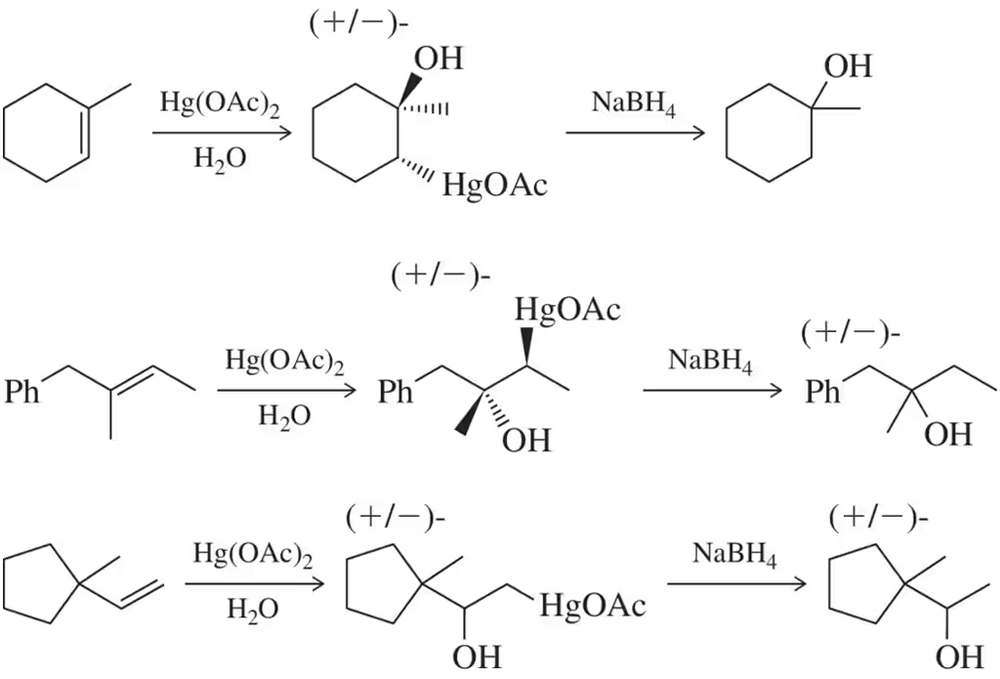
Provide an arrow-pushing mechanism, accounting also for the stereochemical outcome, of the first step (oxymercuration) of the three reactions in Figure 8.63.
Arrow-pushing mechanism for oxymercuration, showing stereochemical outcomes in three reactions with Hg(OAc)2 and NaBH4.

검증된 단계별 안내
1
Identify the reactants involved in the oxymercuration step. Typically, this involves an alkene and mercuric acetate (Hg(OAc)₂) in the presence of water.
Understand the role of the mercuric acetate. It acts as an electrophile, with the mercury atom capable of accepting electrons from the π-bond of the alkene, forming a mercurinium ion intermediate.
Draw the mechanism for the formation of the mercurinium ion. The π-electrons from the alkene attack the mercury atom, forming a cyclic intermediate. Use curved arrows to show the movement of electrons from the alkene to the mercury.
Consider the stereochemical implications. The mercurinium ion is typically formed in a syn-addition manner, meaning both the mercury and the acetate group add to the same face of the alkene, leading to a specific stereochemical outcome.
Illustrate the attack of water on the mercurinium ion. Water acts as a nucleophile, attacking the more substituted carbon of the mercurinium ion, leading to the opening of the ring and formation of an organomercury alcohol. Use curved arrows to show the movement of electrons from water to the carbon atom.

비슷한 문제에 대한 검증된 영상 답변:

이 영상 해법은 위 문제에 도움이 된다고 튜터들이 추천한 것입니다.
영상 길이:
7m

주요 개념

질문에 올바르게 답하기 위해 반드시 이해해야 하는 핵심 개념들은 다음과 같습니다.

Arrow-Pushing Mechanism

Arrow-pushing is a technique used in organic chemistry to depict the movement of electrons during chemical reactions. It involves using curved arrows to show how electron pairs move from nucleophiles to electrophiles, helping to visualize the step-by-step transformation of reactants into products. Understanding this concept is crucial for predicting reaction pathways and outcomes.
추천 영상:
04:32
General Mechanism

Oxymercuration Reaction

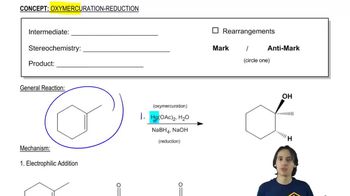
Oxymercuration is a chemical reaction that involves the addition of mercury(II) acetate to an alkene, followed by nucleophilic attack by water, resulting in the formation of an alcohol. This reaction proceeds via a mercurinium ion intermediate and is known for its regioselectivity, typically leading to Markovnikov addition without rearrangement. Grasping this concept is essential for understanding the mechanism and stereochemical aspects of the reaction.
추천 영상:
05:
General properties of oxymercuration-reduction.

Stereochemical Outcome

Stereochemistry refers to the spatial arrangement of atoms in molecules and its influence on chemical reactions. In oxymercuration, the stereochemical outcome is determined by the formation of the mercurinium ion and subsequent nucleophilic attack, which can lead to specific configurations in the product. Recognizing how stereochemistry affects reaction products is vital for predicting and explaining the results of organic reactions.
추천 영상:
가이드 코스
1:19
Peptide Sequencing: Partial Hydrolysis Concept 1