Ch. 8 - Alkenes 1: Properties and Electrophilic Additions
Mullins - Organic Chemistry: A Learner Centered Approach 1st Edition
Mullins1st EditionOrganic Chemistry: A Learner Centered ApproachISBN: 9780137566471당신이 사용하는 게 아니라요?교과서 변경
7장, 문제 57

The first step of oxymercuration–reduction is stereospecific, and yet this fact wasn't emphasized in that discussion. Show the stereospecificity of the first step for the following alkene and then explain why the stereospecificity becomes unimportant after the second step.
Alkene reacts with Hg(OAc)2 and H2O, forming a racemic alcohol product, highlighting stereospecificity.

검증된 단계별 안내
1
Identify the alkene structure involved in the oxymercuration-reduction reaction. The alkene will undergo an addition reaction with mercuric acetate (Hg(OAc)₂) in the presence of water.
Understand that the first step of oxymercuration involves the formation of a mercurinium ion intermediate. This step is stereospecific because the addition of the mercuric acetate occurs from one side of the double bond, leading to a specific stereochemistry in the intermediate.
Illustrate the formation of the mercurinium ion. The alkene's π electrons attack the mercury atom, forming a cyclic mercurinium ion. This intermediate is crucial as it dictates the stereochemistry of the subsequent nucleophilic attack.
Explain that the stereospecificity becomes unimportant after the second step, which is the reduction step. In this step, sodium borohydride (NaBH₄) is used to reduce the mercurinium ion, replacing the mercury with a hydrogen atom. This reduction step is not stereospecific, as it can occur from either side of the intermediate, leading to a mixture of stereoisomers.
Conclude by emphasizing that while the first step is stereospecific, the overall reaction results in a racemic mixture due to the non-stereospecific nature of the reduction step. This is why the stereospecificity of the first step is not emphasized in the overall reaction outcome.

비슷한 문제에 대한 검증된 영상 답변:

이 영상 해법은 위 문제에 도움이 된다고 튜터들이 추천한 것입니다.
영상 길이:
14m

주요 개념

질문에 올바르게 답하기 위해 반드시 이해해야 하는 핵심 개념들은 다음과 같습니다.

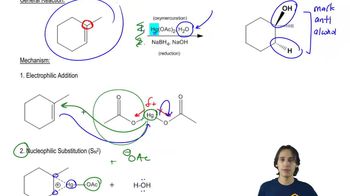
Oxymercuration-Reduction Mechanism

Oxymercuration-reduction is a two-step reaction used to convert alkenes into alcohols. The first step involves the addition of mercuric acetate to the alkene, forming a mercurinium ion intermediate. This step is stereospecific, meaning it occurs with a specific spatial arrangement, often leading to anti-addition. The second step involves reduction with sodium borohydride, which replaces the mercury with a hydrogen atom, completing the transformation to an alcohol.
추천 영상:
09:01
Acid-catalyzed oxymercuration-reduction mechanism

Stereospecificity in Chemical Reactions

Stereospecificity refers to a reaction where a particular stereoisomer of a reactant leads to a specific stereoisomer of the product. In the context of oxymercuration, the formation of the mercurinium ion intermediate is stereospecific, as it dictates the spatial arrangement of atoms in the product. This specificity is crucial in the first step but becomes less relevant in the second step due to the reduction process, which does not alter the stereochemistry established earlier.
추천 영상:
가이드 코스
3:11
Chemical Reactions of Phosphate Anhydrides Concept 1

Importance of Stereochemistry in Reduction

During the reduction step of oxymercuration-reduction, the stereochemistry established in the first step becomes unimportant because the reduction with sodium borohydride is not stereospecific. This step involves the replacement of the mercury atom with a hydrogen atom, which does not affect the spatial arrangement of the remaining atoms. Thus, the stereochemical outcome of the first step does not influence the final product's stereochemistry.
추천 영상:
가이드 코스
1:38
Polymer Stereochemistry Concept 1