Ch. 9 - Alkenes 2: Oxidation and Reduction
Mullins - Organic Chemistry: A Learner Centered Approach 1st Edition
Mullins1st EditionOrganic Chemistry: A Learner Centered ApproachISBN: 9780137566471당신이 사용하는 게 아니라요?교과서 변경
8장, 문제 38a

Conjugated dienes, molecules containing two alkenes separated by one single bond, are discussed in detail in Chapter 21.
(a) Considering the observed ∆H° of hydrogenation, is hexa-1,3-diene (conjugated) or hexa-1,4-diene (unconjugated) more stable?
Comparison of hydrogenation enthalpy changes for conjugated and unconjugated dienes, showing values of -53.7 and -60.2 kcal/mol.

검증된 단계별 안내
1
Understand the concept of conjugation: Conjugated dienes have alternating double and single bonds, allowing for delocalization of π-electrons across the system. This delocalization provides extra stability compared to unconjugated dienes, where the double bonds are isolated and cannot interact.
Recall the relationship between stability and the heat of hydrogenation (∆H°): A lower (more negative) ∆H° of hydrogenation indicates that the molecule releases less energy upon hydrogenation, meaning it is more stable to begin with.
Compare the structures of hexa-1,3-diene and hexa-1,4-diene: Hexa-1,3-diene is a conjugated diene because the double bonds are separated by a single bond, allowing for delocalization. Hexa-1,4-diene is an unconjugated diene because the double bonds are separated by two single bonds, preventing delocalization.
Analyze the observed ∆H° of hydrogenation: The conjugated diene (hexa-1,3-diene) will have a less negative ∆H° of hydrogenation compared to the unconjugated diene (hexa-1,4-diene) due to the additional stability provided by conjugation.
Conclude based on the ∆H° values: Hexa-1,3-diene (conjugated) is more stable than hexa-1,4-diene (unconjugated) because conjugation lowers the energy of the molecule, as evidenced by the less negative ∆H° of hydrogenation.

비슷한 문제에 대한 검증된 영상 답변:

이 영상 해법은 위 문제에 도움이 된다고 튜터들이 추천한 것입니다.
영상 길이:
2m
도움이 되었나요?

주요 개념

질문에 올바르게 답하기 위해 반드시 이해해야 하는 핵심 개념들은 다음과 같습니다.

Conjugated vs. Unconjugated Dienes

Conjugated dienes have alternating double and single bonds, allowing for resonance stabilization, while unconjugated dienes have isolated double bonds. This resonance in conjugated systems leads to lower energy states and increased stability compared to their unconjugated counterparts, which lack this delocalization of electrons.
추천 영상:
03:27
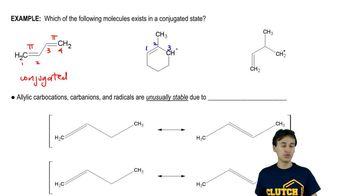
Conjugated states

Hydrogenation and Enthalpy Change (∆H°)

Hydrogenation is the process of adding hydrogen to a compound, typically resulting in the saturation of double bonds. The enthalpy change (∆H°) during hydrogenation indicates the stability of the original compound; a lower ∆H° value suggests greater stability of the starting diene, as less energy is released when converting it to a saturated alkane.
추천 영상:
04:38
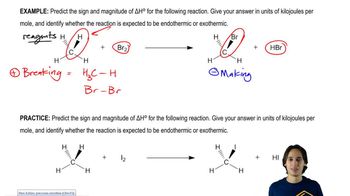
Calculating Enthalpies

Stability and Energy Considerations

In organic chemistry, the stability of a molecule is often inversely related to its energy content. More stable molecules have lower energy due to factors like resonance, sterics, and electronic effects. When comparing hexa-1,3-diene and hexa-1,4-diene, the one with the lower enthalpy of hydrogenation is considered more stable, as it indicates a more favorable energy state.
추천 영상:
03:43
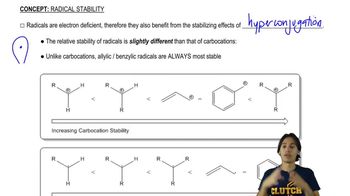
The radical stability trend.