Ch. 9 - Alkenes 2: Oxidation and Reduction
Mullins - Organic Chemistry: A Learner Centered Approach 1st Edition
Mullins1st EditionOrganic Chemistry: A Learner Centered ApproachISBN: 9780137566471당신이 사용하는 게 아니라요?교과서 변경
8장, 문제 38b

Conjugated dienes, molecules containing two alkenes separated by one single bond, are discussed in detail in Chapter 21.
(b) How might you account for this difference in stability?
Comparison of hydrogenation enthalpy changes for conjugated and unconjugated dienes, showing values of -53.7 and -60.2 kcal/mol.

검증된 단계별 안내
1
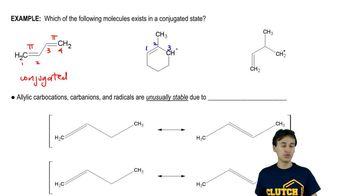
Understand the concept of conjugated dienes: Conjugated dienes are molecules with two double bonds (alkenes) separated by a single bond. This arrangement allows for delocalization of π-electrons across the conjugated system, which contributes to their stability.
Compare conjugated dienes to isolated dienes: In isolated dienes, the double bonds are separated by more than one single bond, preventing π-electron delocalization. This lack of delocalization makes isolated dienes less stable than conjugated dienes.
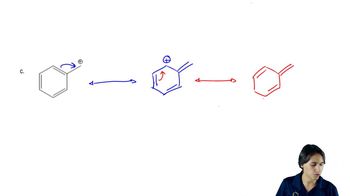
Introduce the concept of resonance: In conjugated dienes, the π-electrons can delocalize over the entire conjugated system, creating resonance structures. Resonance stabilizes the molecule by distributing electron density more evenly.
Discuss molecular orbital theory: The overlap of p-orbitals in conjugated dienes forms a system of molecular orbitals, including bonding and antibonding orbitals. The electrons occupy the lower-energy bonding orbitals, which further stabilizes the molecule.
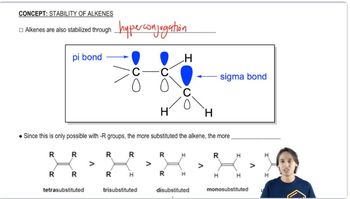
Explain hyperconjugation and bond length: In conjugated dienes, the single bond between the two double bonds often has partial double-bond character due to delocalization. This shortens the bond length and increases stability compared to a typical single bond.

비슷한 문제에 대한 검증된 영상 답변:

이 영상 해법은 위 문제에 도움이 된다고 튜터들이 추천한 것입니다.
영상 길이:
4m
도움이 되었나요?

주요 개념

질문에 올바르게 답하기 위해 반드시 이해해야 하는 핵심 개념들은 다음과 같습니다.

Conjugation

Conjugation refers to the overlap of p-orbitals across adjacent double bonds or a double bond and a single bond, allowing for delocalization of electrons. This delocalization stabilizes the molecule by lowering its energy, making conjugated systems more stable than isolated double bonds. In conjugated dienes, the alternating single and double bonds create a system where the electrons can move freely, enhancing stability.
추천 영상:
03:27
Conjugated states

Resonance

Resonance is a concept in organic chemistry that describes the way in which the structure of a molecule can be represented by multiple valid Lewis structures. These structures, known as resonance forms, contribute to the overall stability of the molecule. In conjugated dienes, resonance allows for the distribution of electron density across the molecule, further stabilizing it compared to non-conjugated systems.
추천 영상:
03:04
Drawing Resonance Structures

Hyperconjugation

Hyperconjugation is the interaction between the electrons in a sigma bond (usually C-H or C-C) and an adjacent empty or partially filled p-orbital or π-bond. This effect can provide additional stability to alkenes and conjugated systems by allowing for the overlap of orbitals, which helps to lower the energy of the molecule. In conjugated dienes, hyperconjugation can enhance stability by allowing for more favorable interactions between the bonds.
추천 영상:
04:28
Understanding trends of alkene stability.
관련 실천
교과서 질문

Without concerning yourself with the mechanism of the reaction, calculate the equilibrium constant for the following equilibrium processes. (Assume T = 298 K.)

(a)

1033
views

교과서 질문

Identify the alkene that would react with Ti(OiPr)₄, (+) -diethyltartrate, and t-butylhydroperoxide to give the following chiral, nonracemic epoxides.

(a)

861
views
교과서 질문

Questions (a)–(d) all refer to the following reaction, which has been engineered to produce one enantiomer to the exclusion of the other.

(c) Suppose the difference in activation energy is 1.6 kcal/mol. At what temperature would you produce C in 99% ee?

983
views
교과서 질문

Identify the alkene that would react with Ti(OiPr)4, (+) -diethyltartrate, and t-butylhydroperoxide to give the following chiral, nonracemic epoxides.

(b)

585
views
교과서 질문

Because deuterium behaves like hydrogen in chemical reactions yet is detected differently, chemists use the incorporation of deuterium to better understand the subtleties of reaction mechanisms. Deuterium is incorporated by replacing H₂ with D₂ in the hydrogenation reaction. Identify the product expected when the alkenes in Assessment 9.34 react with D₂ and Pd/C. [Don't worry about showing all diastereomers.]

1609
views
교과서 질문

Conjugated dienes, molecules containing two alkenes separated by one single bond, are discussed in detail in Chapter 21.

(a) Considering the observed ∆H° of hydrogenation, is hexa-1,3-diene (conjugated) or hexa-1,4-diene (unconjugated) more stable?

1302
views