Ch. 9 - Alkenes 2: Oxidation and Reduction
Mullins - Organic Chemistry: A Learner Centered Approach 1st Edition
Mullins1st EditionOrganic Chemistry: A Learner Centered ApproachISBN: 9780137566471당신이 사용하는 게 아니라요?교과서 변경
8장, 문제 40b

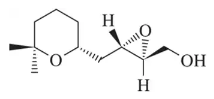
Identify the alkene that would react with Ti(OiPr)4, (+) -diethyltartrate, and t-butylhydroperoxide to give the following chiral, nonracemic epoxides.
(b)

검증된 단계별 안내
1
Recognize that the problem involves the Sharpless epoxidation, a method for the enantioselective epoxidation of allylic alcohols using a titanium catalyst, a chiral tartrate ester, and an oxidizing agent.
Identify the reagents: Ti(OiPr)4 is titanium isopropoxide, (+)-diethyltartrate is the chiral ligand, and t-butylhydroperoxide is the oxidizing agent.
Understand that the reaction is stereospecific and will produce an epoxide with a specific stereochemistry based on the chirality of the tartrate used.
Analyze the given chiral epoxide structure to determine the stereochemistry of the epoxide group. This will help in identifying the correct alkene precursor.
Determine the structure of the alkene that would lead to the given epoxide by considering the position of the double bond in relation to the hydroxyl group in the allylic alcohol precursor. The double bond should be adjacent to the hydroxyl group to allow for the formation of the epoxide with the correct stereochemistry.

비슷한 문제에 대한 검증된 영상 답변:

이 영상 해법은 위 문제에 도움이 된다고 튜터들이 추천한 것입니다.
영상 길이:
7m
도움이 되었나요?

주요 개념

질문에 올바르게 답하기 위해 반드시 이해해야 하는 핵심 개념들은 다음과 같습니다.

Epoxidation

Epoxidation is a chemical reaction that converts alkenes into epoxides, which are three-membered cyclic ethers. This reaction typically involves the addition of an oxygen atom across the double bond of the alkene, resulting in a highly reactive epoxide. The reaction can be facilitated by various reagents, including peracids or metal catalysts, and is significant in organic synthesis for creating chiral centers.
추천 영상:
02:19
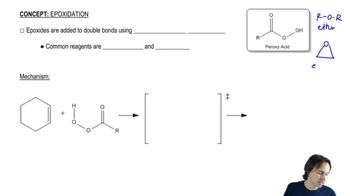
General properties of epoxidation.

Chirality and Stereochemistry

Chirality refers to the geometric property of a molecule having non-superimposable mirror images, known as enantiomers. In organic chemistry, chirality is crucial for understanding the behavior of molecules in biological systems, as different enantiomers can have vastly different effects. The stereochemistry of a reaction, including the configuration of chiral centers, is essential for predicting the outcome of reactions, such as the formation of nonracemic products.
추천 영상:
가이드 코스
1:21
Polymer Stereochemistry Example 1

Ti(OiPr)4 and Asymmetric Catalysis

Titanium isopropoxide (Ti(OiPr)4) is a common catalyst used in asymmetric synthesis, particularly in the formation of chiral epoxides. It facilitates the reaction by coordinating to the alkene and directing the addition of the oxidizing agent in a stereoselective manner. The use of chiral ligands, such as (+)-diethyltartrate, enhances the selectivity of the reaction, leading to the formation of nonracemic products with defined stereochemistry.
추천 영상:
가이드 코스
2:31
Nucleophilic Catalysis Concept 1