Ch. 9 - Alkenes 2: Oxidation and Reduction
Mullins - Organic Chemistry: A Learner Centered Approach 1st Edition
Mullins1st EditionOrganic Chemistry: A Learner Centered ApproachISBN: 9780137566471당신이 사용하는 게 아니라요?교과서 변경
8장, 문제 45h(viii)

Predict the product(s) that would result when the alkenes are allowed to react under the following conditions: (viii) 1. O3 2. CH3SCH3
(h) Chemical structure of an alkene with a double bond, illustrating a reaction mechanism for ozonolysis.

검증된 단계별 안내
1
Step 1: Recognize the reaction type. The reaction involves ozonolysis of an alkene, which is a process where the double bond of the alkene is cleaved by ozone (O₃) to form carbonyl compounds (aldehydes or ketones). The second step, using dimethyl sulfide (CH₃SCH₃), is a reductive workup that prevents the formation of carboxylic acids.
Step 2: Identify the structure of the alkene. Determine the position of the double bond in the given alkene structure. The double bond will be the site of cleavage during the reaction.
Step 3: Break the double bond. Conceptually split the double bond into two parts, and attach an oxygen atom to each carbon that was originally part of the double bond. This forms two carbonyl groups.
Step 4: Determine the type of carbonyl compounds formed. If the carbon attached to the double bond has one hydrogen, the product will be an aldehyde. If it has no hydrogens, the product will be a ketone. Use this rule to assign the correct carbonyl products.
Step 5: Confirm the reductive workup. The use of CH₃SCH₃ ensures that the products remain aldehydes or ketones, as it prevents further oxidation to carboxylic acids. Write the final products based on the cleavage and the reductive workup conditions.

비슷한 문제에 대한 검증된 영상 답변:

이 영상 해법은 위 문제에 도움이 된다고 튜터들이 추천한 것입니다.
도움이 되었나요?

주요 개념

질문에 올바르게 답하기 위해 반드시 이해해야 하는 핵심 개념들은 다음과 같습니다.

Ozonolysis

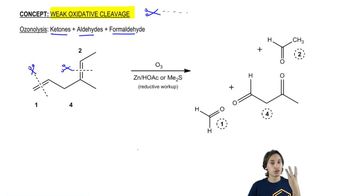
Ozonolysis is a reaction involving the cleavage of alkenes using ozone (O₃), resulting in the formation of carbonyl compounds such as aldehydes or ketones. The reaction typically proceeds through the formation of a cyclic ozonide intermediate, which is then reduced to yield the final products. Understanding this process is crucial for predicting the products of the reaction in the given question.
추천 영상:
06:30
General properties of ozonolysis.

Thioether Reduction

In the context of the reaction, thioethers like dimethyl sulfide (CH₃SCH₃) can act as reducing agents. After ozonolysis, the carbonyl compounds formed can be further reduced by thioethers, leading to the formation of alcohols. Recognizing the role of thioethers in this reduction process is essential for determining the final products of the reaction.
추천 영상:
07:12
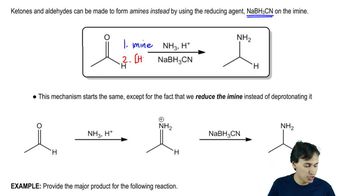
Reductive Amination

Regioselectivity

Regioselectivity refers to the preference of a chemical reaction to yield one structural isomer over others when multiple possibilities exist. In ozonolysis, the position of the double bond in the alkene influences the location of the carbonyl groups formed. Understanding regioselectivity helps in predicting which products will be favored in the reaction under the specified conditions.
추천 영상:
05:09
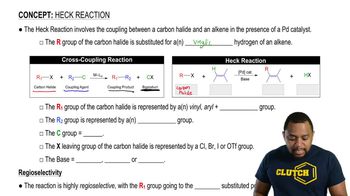
Heck Reaction