Ch. 9 - Alkenes 2: Oxidation and Reduction
Mullins - Organic Chemistry: A Learner Centered Approach 1st Edition
Mullins1st EditionOrganic Chemistry: A Learner Centered ApproachISBN: 9780137566471당신이 사용하는 게 아니라요?교과서 변경
8장, 문제 45k(iii)

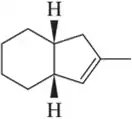
Predict the product(s) that would result when the alkenes are allowed to react under the following conditions: (iii) Br2, H2O
(k) Chemical structure of an alkene with hydrogen atoms, illustrating a reaction mechanism for halohydrin formation.

검증된 단계별 안내
1
Identify the type of reaction: The reaction involves an alkene reacting with bromine (Br₂) in the presence of water (H₂O). This is a halohydrin formation reaction, where the alkene undergoes an electrophilic addition reaction.
Understand the mechanism: The π-electrons of the alkene attack the bromine molecule (Br₂), forming a bromonium ion intermediate. This intermediate is a three-membered ring with a positive charge on the bromine atom.
Determine the role of water: Water acts as a nucleophile in this reaction. It attacks the more substituted carbon of the bromonium ion (due to the partial positive charge being more stabilized on the more substituted carbon), leading to the opening of the bromonium ring.
Assign regioselectivity: The product will follow Markovnikov's rule, where the -OH group from water attaches to the more substituted carbon, and the bromine atom attaches to the less substituted carbon.
Draw the final product: The result is a halohydrin, where the -OH group and the bromine atom are added anti to each other (on opposite sides of the former double bond plane). Ensure stereochemistry is considered if the alkene is asymmetric.

비슷한 문제에 대한 검증된 영상 답변:

이 영상 해법은 위 문제에 도움이 된다고 튜터들이 추천한 것입니다.
영상 길이:
2m
도움이 되었나요?

주요 개념

질문에 올바르게 답하기 위해 반드시 이해해야 하는 핵심 개념들은 다음과 같습니다.

Electrophilic Addition

Electrophilic addition is a fundamental reaction mechanism in organic chemistry where an electrophile reacts with a nucleophile, typically involving alkenes. In the case of alkenes reacting with Br₂, the double bond acts as a nucleophile, attacking the electrophilic bromine molecule, leading to the formation of a cyclic bromonium ion intermediate.
추천 영상:
09:23
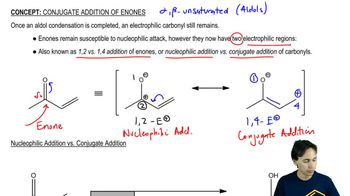
1,2 vs 1,4 Addition

Bromohydrin Formation

Bromohydrin formation occurs when an alkene reacts with bromine in the presence of water. The bromonium ion intermediate is attacked by water, leading to the formation of a bromohydrin, which is a compound containing both a bromine atom and a hydroxyl group (-OH) on adjacent carbon atoms, resulting in a Markovnikov addition pattern.
추천 영상:
02:26
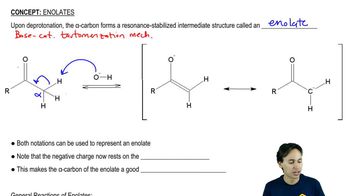
Formation of Enolates

Regioselectivity

Regioselectivity refers to the preference of a chemical reaction to yield one structural isomer over others when multiple products are possible. In the reaction of alkenes with Br₂ and H₂O, regioselectivity is influenced by the stability of the carbocation intermediates formed during the reaction, often leading to the more substituted product being favored according to Markovnikov's rule.
추천 영상:
05:09
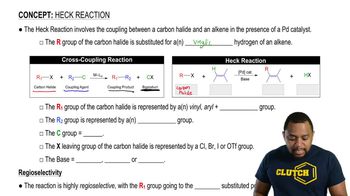
Heck Reaction