뒤로
뒤로
문제 31
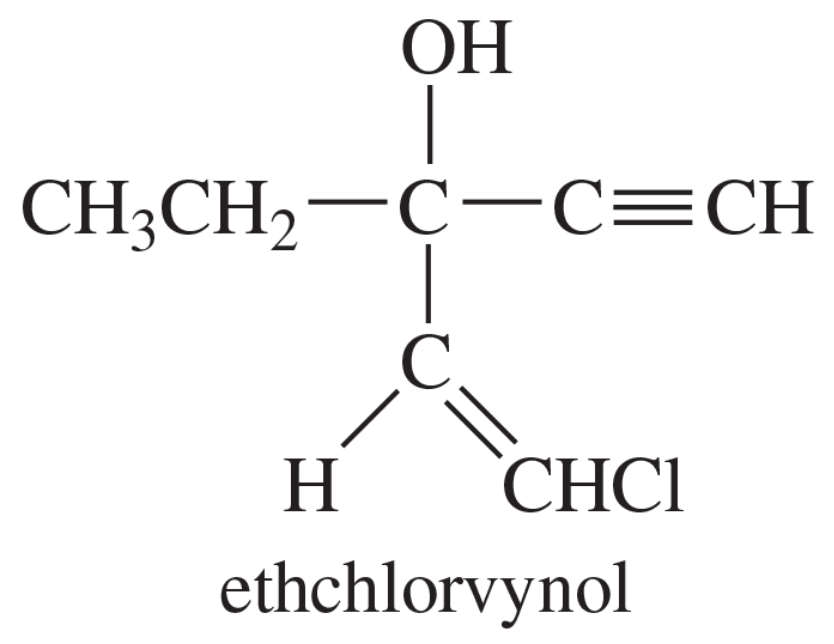
The application box in the margin of states, “The addition of an acetylide ion to a carbonyl group is used in the synthesis of ethchlorvynol, a drug used to cause drowsiness and induce sleep.” Show how you would accomplish this synthesis from acetylene and a carbonyl compound.
문제 32
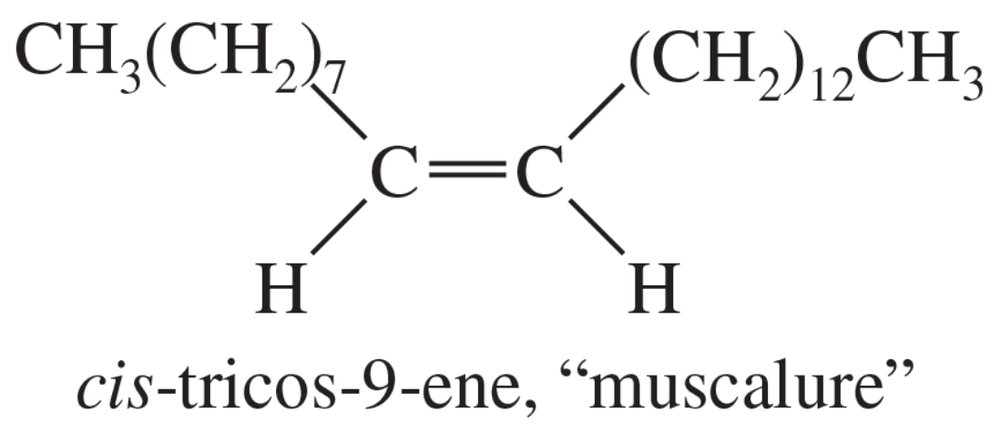
Muscalure, the sex attractant of the common housefly, is cis-tricos-9-ene. Most syntheses of alkenes give the more stable trans isomer as the major product. Devise a synthesis of muscalure from acetylene and other compounds of your choice. Your synthesis must give specifically the cis isomer of muscalure.
문제 33ab,c
Predict the products of reaction of pent-1-yne with the following reagents.
a. 1 equivalent of HCl
b. 2 equivalents of HCl
c. excess H2, Ni
문제 33d,e,f
Predict the products of reaction of pent-1-yne with the following reagents.
d. H2, Pd/BaSO4, quinoline
e. 1 equivalent of Br2
f. 2 equivalents of Br2
문제 33g,h,i
Predict the products of reaction of pent-1-yne with the following reagents.
g. cold, dilute KMnO4
h. warm, concd. KMnO4, NaOH
i. Na, liquid ammonia
문제 33j,k,l
Predict the products of reaction of pent-1-yne with the following reagents.
j. NaNH2
k. H2SO4/HgSO4, H2O
l. Sia2BH, then H2O2, –OH
문제 34a
Show how you would accomplish the following synthetic transformations. Show all intermediates.
a. 2,2-dibromobutane → but-1-yne
문제 34b
Show how you would accomplish the following synthetic transformations. Show all intermediates.
b. 2,2-dibromobutane → but-2-yne
문제 34c
Show how you would accomplish the following synthetic transformations. Show all intermediates.
c. but-1-yne → oct-3-yne
문제 34d
Show how you would accomplish the following synthetic transformations. Show all intermediates.
d. trans-hex-2-ene → hex-2-yne
문제 34e
Show how you would accomplish the following synthetic transformations. Show all intermediates.
e. 2,2-dibromohexane → hex-1-yne
문제 34f
Show how you would accomplish the following synthetic transformations. Show all intermediates.
f. cyclodecyne → cis-cyclodecene
문제 34g
Show how you would accomplish the following synthetic transformations. Show all intermediates.
g. cyclodecyne → trans-cyclodecene
문제 34h
Show how you would accomplish the following synthetic transformations. Show all intermediates.
h. hex-1-yne → hexan-2-one, CH3COCH2CH2CH2CH3
문제 34i
Show how you would accomplish the following synthetic transformations. Show all intermediates.
i. hex-1-yne → hexanal, CH3(CH2)4CHO
문제 34j
Show how you would accomplish the following synthetic transformations. Show all intermediates.
j. trans-hex-2-ene → cis-hex-2-ene
문제 35a,b
Show how you would synthesize the following compounds from acetylene and any other needed reagents:
(a) 6-phenylhex-1-en-4-yne
(b) cis-1-phenylpent-2-ene
문제 36a,b,c
Predict the products formed when CH3CH2–C≡C:–Na+ reacts with the following compounds.
a. ethyl bromide
b. tert-butyl bromide
c. formaldehyde
문제 36d,e
Predict the products formed when CH3CH2–C≡C:–Na+ reacts with the following compounds.
(d) cyclohexanone
(e) CH3CH2CH2CHO
문제 37a,b,c
Show how you would synthesize the following compounds, starting with acetylene and any compounds containing no more than four carbon atoms.
a. hex-1-yne
b. hex-2-yne
c. cis-hex-2-ene
문제 37d,e,f
Show how you would synthesize the following compounds, starting with acetylene and any compounds containing no more than four carbon atoms.
d. trans-hex-2-ene
e. 1,1-dibromohexane
f. 2,2-dibromohexane
문제 37g,h,i
Show how you would synthesize the following compounds, starting with acetylene and any compounds containing no more than four carbon atoms.
g. pentanal, CH3CH2CH2CH2CHO
h. pentan-2-one, CH3–CO–CH2CH2CH3
i. (±) 3,4-dibromohexane
문제 38
When treated with hydrogen and a platinum catalyst, an unknown compound X absorbs 5 equivalents of hydrogen to give n-butylcyclohexane. Treatment of X with an excess of ozone, followed by dimethyl sulfide and water, gives the following products:
Propose a structure for the unknown compound X. Is there any uncertainty in your structure?
문제 39
When compound Z is treated with ozone, followed by dimethyl sulfide and washing with water, the products are formic acid, 3-oxobutanoic acid, and hexanal.
Propose a structure for compound Z. What uncertainty is there in the structure you have proposed?
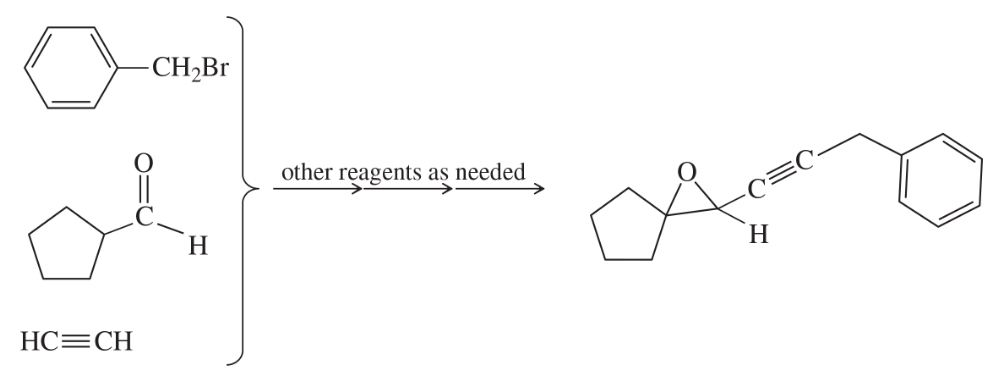
문제 40
Show how you would convert the following starting materials into the target compound. You may use any additional reagents you need.
문제 41a,b
The following functional-group interchange is a useful synthesis of aldehydes.
(a) What reagents were used in this chapter for this transformation? Give an example to illustrate this method.
(b) This functional-group interchange can also be accomplished using the following sequence.
Propose mechanisms for these steps.
문제 41c
The following functional-group interchange is a useful synthesis of aldehydes.
(c) Explain why a nucleophilic reagent such as ethoxide adds to an alkyne more easily than it adds to an alkene.
문제 42a
Using any necessary inorganic reagents, show how you would convert acetylene and isobutyl bromide to
(a) meso-2,7-dimethyloctane-4,5-diol, (CH3)2CHCH2CH(OH)CH(OH)CH2CH(CH3)2.
문제 42b
Using any necessary inorganic reagents, show how you would convert acetylene and isobutyl bromide to
(b) (±)-2,7-dimethyloctane-4,5-diol.
문제 43a
Deduce the structure of each compound from the information given. All unknowns in this problem have molecular formula C8H12.
(a) Upon catalytic hydrogenation, unknown W gives cyclooctane. Ozonolysis of W, followed by reduction with dimethyl sulfide, gives octanedioic acid, HOOC–(CH2)6–COOH. Draw the structure of W.