Back
Back
Problem 1
Define the following key terms.
a. Fomite
b. Mucociliary escalator
c. Alveolar macrophage
d. Prognosis
e. Serovar
f. Otitis media
g. Tympanic membrane
h. Epidemic
i. Pandemic
j. Antigenic drift
k. Herd immunity
l. Antigenic shift
m. Rheumatogenic
n. Attenuated viral strain
o. Inactivated viral strain
p. Pulmonary edema
q. Community-acquired pneumonia (CAP)
r. Healthcare-associated pneumonia (HCAP)
s. Typical pneumonia
t. Atypical pneumonia
u. Endemic mycoses
v. Dimorphic fungus
Problem 2
List the anatomical structures of the human upper respiratory tract.
Problem 3
List the anatomical structures of the human lower respiratory tract.
Problem 4
Which of the following can lead to pneumonia?
a. Viruses
b. Bacteria
c. Fungi
d. All of the above
Problem 5
Most cases of croup are caused by
a. Bacteria.
b. Viruses.
c. Trauma injuries.
d. Fungi.
e. Allergens.
Problem 6
Select the FALSE statement:
a. Typical pneumonia can be community acquired.
b. Streptococcus pneumoniae is one cause of typical pneumonia.
c. Viruses are the only cause of atypical pneumonia.
d. Atypical pneumonia is not usually characterized by consolidation.
Problem 7
Rapid diagnosis and treatment of streptococcal pharyngitis (strep throat) are important mainly because
a. Streptococcal pharyngitis is painful.
b. Streptococcal pharyngitis is highly contagious.
c. Failure to treat streptococcal pharyngitis can compromise the efficiency of the DTaP vaccine.
d. Streptococcal pharyngitis can cause certain autoimmune complications.
e. Not treating streptococcal pharyngitis leads to antibiotic resistance.
Problem 8
The __________ vaccine is a childhood vaccine to protect against tetanus, diphtheria, and pertussis; in contrast, the __________ vaccine is a booster shot recommended for adolescents and adults to protect against tetanus, diphtheria, and pertussis.
Problem 9
List the three stages of pertussis, and provide some general characteristics of each stage.
Problem 10
Give two reasons why the bacillus Calmette–Guérin (BCG) vaccine is not routinely recommended in the United States to prevent tuberculosis.
Problem 11
Indicate the true statements, and then correct the false statements so that they are true.
a. The most common viruses that cause human respiratory system infections are cold viruses.
b. Viruses can be treated with antibiotics.
c. People who have been exposed to cold and/or wet conditions are statistically more likely to develop a cold.
d. Many respiratory illnesses that are not caused by influenza viruses have flu-like symptoms.
e. The flu vaccine is not recommended for children under 2 years of age.
f. Pneumonia is a rare healthcare-acquired infection.
Problem 12
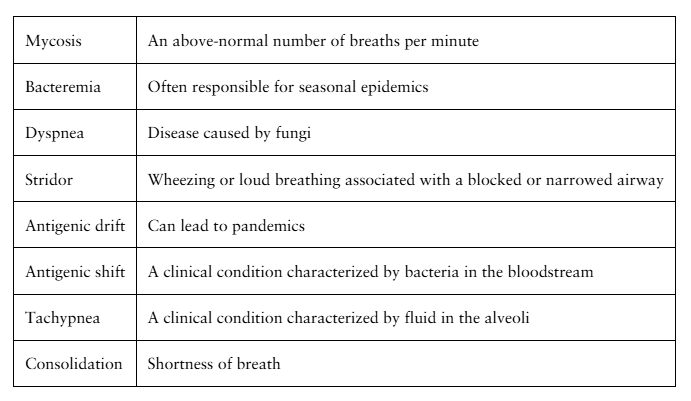
Match the following:
Problem 13
Choose the general agent of the disease (select ONE choice of agent from the options after each illness):
a. Pneumococcal pneumonia is caused by a (virus, bacterium, fungus).
b. Pneumocystis pneumonia is caused by a (virus, bacterium, fungus).
c. Tuberculosis is caused by a (virus, bacterium, fungus).
d. Histoplasmosis is caused by a (virus, bacterium, fungus).
e. Influenza is caused by a (virus, bacterium, fungus).
f. Colds are caused by (viruses, bacteria, fungi).
g. Coccidioidomycosis is caused by a (virus, bacterium, fungus).
h. Diphtheria is caused by a (virus, bacterium, fungus).
i. Pertussis is caused by a (virus, bacterium, fungus).
j. Scarlet fever is caused by a (virus, bacterium, fungus).
k. Legionellosis is caused by a (virus, bacterium, fungus).
l. Q fever is caused by a (virus, bacterium, fungus).
m. Hanta pulmonary syndrome is caused by a (virus, bacterium, fungus).
n. Streptococcal pharyngitis is caused by a (virus, bacterium, fungus).
Problem 15
From the following list, select all of the diseases that antibiotics do not directly cure.
a. Hanta pulmonary syndrome
b. Streptococcus pneumoniae
c. Colds
d. Influenza
e. Haemophilus influenzae
f. COVID-19
g. Legionellosis
h. Tularemia
Problem 16
Select the true statements about SARS-CoV-2. (Select all that apply.)
a. It causes COVID-19.
b. It is vaccine preventable.
c. The FDA has approved hydroxychloroquine to treat infections with this virus.
d. It is considered a zoonotic infection.
e. It causes a form of viral pneumonia.
Problem 17
Which of the following would you expect for a SARS-CoV-2 variant that is classified as a variant of interest? (Select all that apply.)
a. The isolated virus is genetically unique as compared to earlier circulating versions of SARS-CoV-2.
b. There is evidence that the variant completely evades vaccine-induced immunity.
c. The variant is broadly detectable with current diagnostic tools.
d. The variant can cause viral pneumonia.
e. Infections caused by the variant are not treatable with existing approved drug therapies.