Ch. 16 - Respiratory System Infections
Norman-McKay- Microbiology: Basic and Clinical Principles 2nd Edition
Norman-McKay2nd EditionMicrobiology: Basic and Clinical PrinciplesISBN: 9780137661619Not the one you use?Change textbook
Chapter 16, Problem 1

Define the following key terms.
a. Fomite
b. Mucociliary escalator
c. Alveolar macrophage
d. Prognosis
e. Serovar
f. Otitis media
g. Tympanic membrane
h. Epidemic
i. Pandemic
j. Antigenic drift
k. Herd immunity
l. Antigenic shift
m. Rheumatogenic
n. Attenuated viral strain
o. Inactivated viral strain
p. Pulmonary edema
q. Community-acquired pneumonia (CAP)
r. Healthcare-associated pneumonia (HCAP)
s. Typical pneumonia
t. Atypical pneumonia
u. Endemic mycoses
v. Dimorphic fungus

Verified step by step guidance
1
Define 'Fomite' as an inanimate object or surface that can carry and transmit infectious agents to a host.
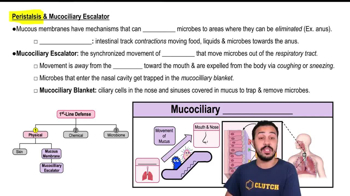
Explain 'Mucociliary escalator' as a defense mechanism in the respiratory tract where mucus traps particles and cilia move the mucus upward to clear pathogens and debris.
Describe 'Alveolar macrophage' as immune cells located in the alveoli of the lungs that engulf and digest pathogens and particles.
Clarify 'Prognosis' as the predicted outcome or course of a disease, including chances of recovery or progression.
Define 'Serovar' as a distinct variation within a species of bacteria or virus, classified based on antigenic properties.

Verified video answer for a similar problem:

This video solution was recommended by our tutors as helpful for the problem above.
Video duration:
3m
Was this helpful?

Key Concepts

Here are the essential concepts you must grasp in order to answer the question correctly.

Fomite

A fomite is any inanimate object or surface that can carry infectious agents and facilitate their transmission between hosts. Common examples include doorknobs, utensils, and medical equipment. Understanding fomites is crucial for infection control and prevention.

Mucociliary Escalator

The mucociliary escalator is a defense mechanism in the respiratory tract where mucus traps inhaled particles and cilia move the mucus upward toward the throat for expulsion. This process helps prevent pathogens from reaching the lungs and causing infection.
Recommended video:
Guided course
04:14
Peristalsis & Mucociliary Escalator

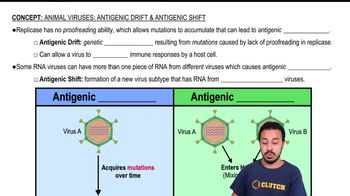
Antigenic Drift and Shift

Antigenic drift refers to small, gradual genetic mutations in viral surface proteins that allow evasion of immune detection, common in influenza viruses. Antigenic shift is a sudden, major change resulting from reassortment of viral genomes, potentially causing pandemics due to new viral strains.
Recommended video:
Guided course
05:27
Animal Viruses: Antigenic Drift vs. Antigenic Shift