Ch. 27 - Carbohydrates, Nucleic Acids, and Lipids
Mullins - Organic Chemistry: A Learner Centered Approach 1st Edition
Mullins1st EditionOrganic Chemistry: A Learner Centered ApproachISBN: 9780137566471Not the one you use?Change textbook
Chapter 26, Problem 9c

Convert each line-angle drawing, using appropriate bond rotations, into a correct Fischer projection.
(c)

Verified step by step guidance
1
Identify the chiral centers in the ketopentose structure. In this case, the chiral centers are the carbon atoms bonded to the hydroxyl (OH) groups.
Determine the configuration (R or S) of each chiral center by assigning priorities to the substituents based on atomic number and using the Cahn-Ingold-Prelog rules.
Visualize the molecule in a way that places the carbon chain vertically, with the most oxidized carbon (the ketone group) at the top. This is the standard orientation for Fischer projections.
Rotate the bonds around the chiral centers to ensure that the horizontal bonds (in the Fischer projection) are coming out of the plane towards the viewer, while the vertical bonds are going into the plane.
Draw the Fischer projection by placing the chiral centers vertically, with the appropriate substituents on the left and right, based on the bond rotations and configurations determined in the previous steps.

Verified video answer for a similar problem:

This video solution was recommended by our tutors as helpful for the problem above.
Video duration:
4m
Was this helpful?

Key Concepts

Here are the essential concepts you must grasp in order to answer the question correctly.

Line-Angle Drawings

Line-angle drawings are a simplified way of representing organic molecules where lines represent bonds between atoms, and vertices represent carbon atoms. This notation omits hydrogen atoms attached to carbons, making it easier to visualize complex structures. Understanding how to interpret these drawings is crucial for converting them into other representations, such as Fischer projections.
Recommended video:
Guided course
02:46
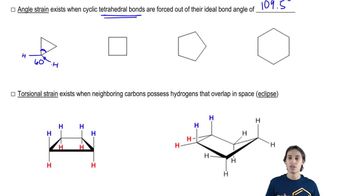
What is angle strain?

Fischer Projections

Fischer projections are a two-dimensional representation of three-dimensional organic molecules, particularly useful for depicting stereochemistry. In these projections, vertical lines represent bonds that extend behind the plane of the page, while horizontal lines represent bonds that come out of the page. Mastery of Fischer projections is essential for accurately conveying the spatial arrangement of substituents around chiral centers.
Recommended video:
Guided course
09:56
Monosaccharides - Drawing Fischer Projections

Stereochemistry and Bond Rotation

Stereochemistry involves the study of the spatial arrangement of atoms in molecules and how this affects their chemical behavior. Bond rotation refers to the ability to rotate around single bonds, which can change the conformation of a molecule. Understanding how to manipulate bond rotations is vital when converting line-angle drawings to Fischer projections, as it ensures the correct representation of stereochemical configurations.
Recommended video:
1:21
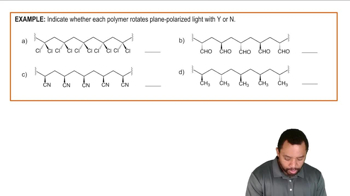
Polymer Stereochemistry Example 1